
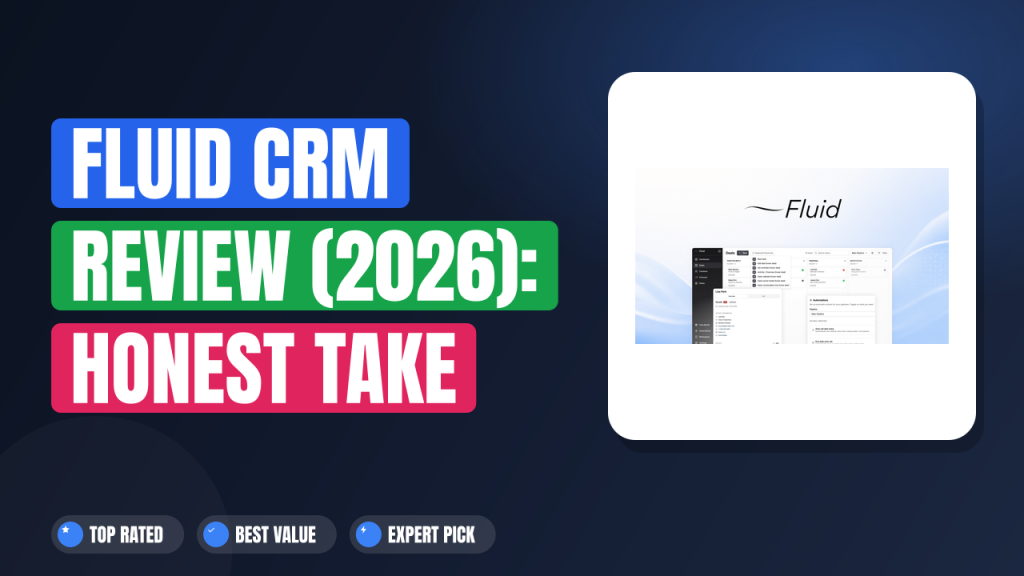
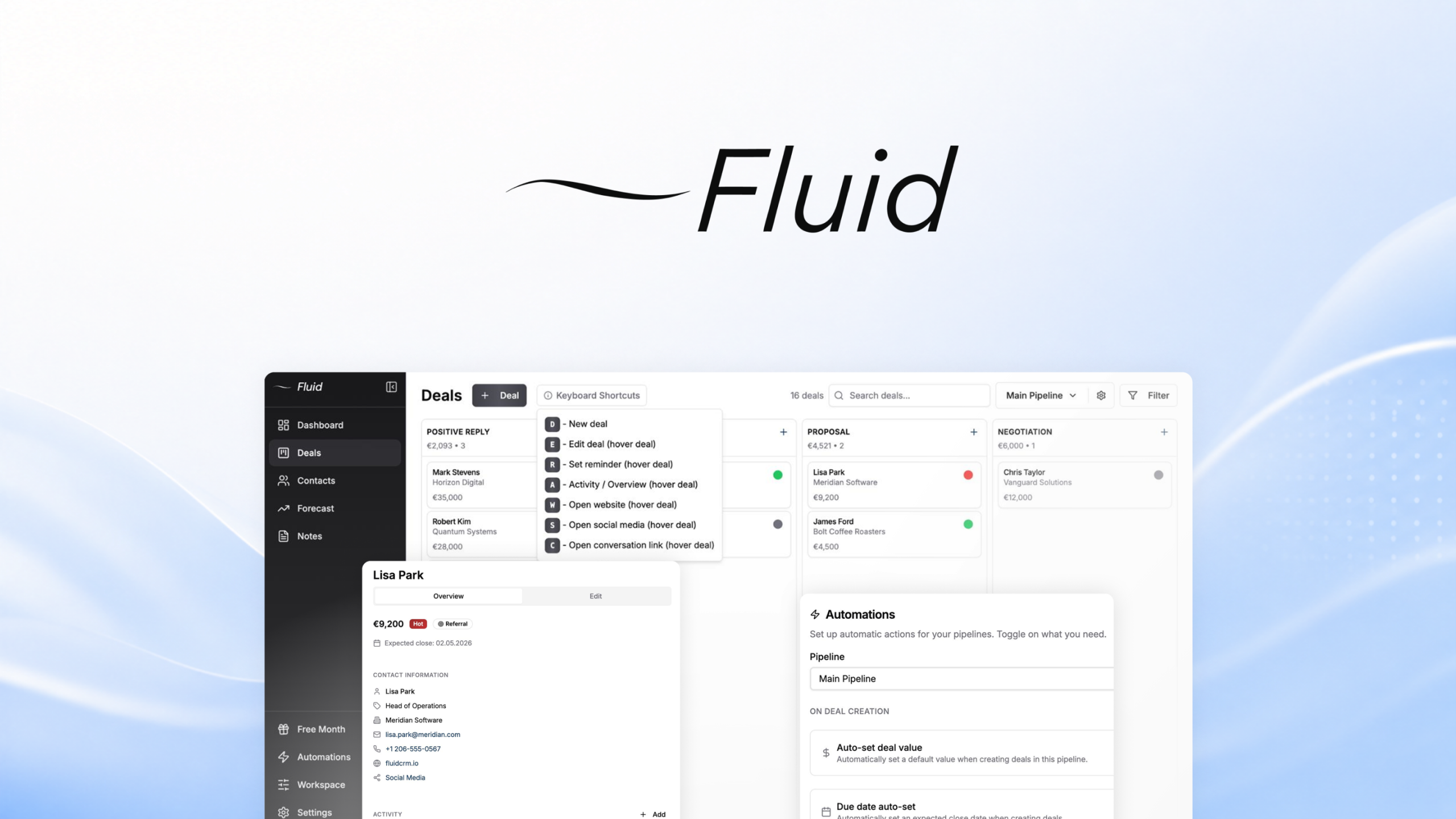
Fluid CRM is a lifetime-deal CRM built for small B2B teams who have outgrown their spreadsheet but do not want to pay HubSpot money for features they will never touch. Its strongest selling point is the calm visual pipeline: pipeline value, active deals, and overdue follow-ups sit on the first screen you see.
Disclosure: This article contains affiliate links. We may earn a small commission at no extra cost to you when you sign up via our links, it's how this site stays free to run.
TL;DR Verdict
- Who it's for: consultants, sales managers, and B2B teams of 1 to 25 seats running a repeatable deal process.
- Headline price: $59 one-time for one seat, $118 for eight seats, $177 for 25 seats. Lifetime access, no monthly bill.
- Biggest pro: the login screen answers "what needs attention today" without a single click.
- Biggest con: the product launched in November 2025, so the review base is still small and there is no public mobile app.
- Free trial: no trial period, but AppSumo covers the purchase with a 60-day money-back guarantee.
Bottom line: if you want a fast, visual sales pipeline and you hate subscriptions, Get the Lifetime Deal →.
What Is Fluid CRM?
Fluid CRM is a visual sales pipeline tool that helps small B2B teams track deals, contacts, and follow-ups without the overhead of an enterprise CRM. It was founded in Helsinki, Finland in November 2025 by Omar Abdalla, and it sells through AppSumo as a one-time purchase rather than a monthly plan.
The job it solves is narrow and specific. Most small teams run their pipeline in a spreadsheet until the spreadsheet breaks. Deals get duplicated, follow-up dates slip, and nobody can tell you the total value of stage two without opening three tabs.
Fluid CRM replaces that spreadsheet with a drag-and-drop pipeline, per-deal notes, and reminders that surface overdue work on the dashboard.
It also targets the opposite problem: enterprise CRMs that take six weeks to configure and charge per seat forever. Vendor documentation describes Fluid as built from work with 50+ small B2B teams, with customization focused on fields, pipelines, and stages rather than a giant feature catalogue. If you have compared another lightweight sales tool before, the pitch will feel familiar, but the lifetime pricing is the differentiator.
Key Features That Matter
A dashboard that leads with what is late
The dashboard shows active deals, total pipeline value, and overdue reminders the moment you log in. Pipeline value is tracked by stage and updates in real time, so you can see whether your forecast is drifting before the end of the month. For a two-person sales team, that single screen replaces a Monday morning status meeting.
Drag-and-drop pipelines with custom stages
You can create multiple pipelines and move deals between stages by dragging a card. Each pipeline supports its own custom deal fields, which matters if you sell a $2,000 retainer and a $40,000 implementation through different processes. Contacts are created automatically when you add a new deal, which removes a common data-entry step.
Follow-up reminders and a daily digest
Reminders take two clicks to set on any deal, and the daily digest emails you the list of follow-ups due. Aggregate reviews on the AppSumo listing consistently mention not letting prospects go cold as the reason people stay subscribed to the habit. This is the feature that replaces the sticky note on your monitor.
Eight in-app automations
Fluid ships with eight in-app automations that trigger on deal events, so manual CRM chores like stage updates and task creation happen without you. The count is capped rather than unlimited, which keeps the interface simple but limits complex routing. Teams that need deep branching logic will still reach for Pabbly or a webhook to an external tool.
MCP support for AI agents
Fluid CRM exposes an MCP connection, which lets Claude, ChatGPT, or another AI agent read and edit your CRM data inside the chat window. According to the official documentation, the agent works against your live records rather than a static export. If you are already connecting AI assistants to your other work tools, this is the most forward-looking part of the product.
Integrations: REST API, Pabbly Connect, webhooks
The REST API, Pabbly Connect, and webhooks cover most of the plumbing a small team needs. You can push new leads in from a form, or fire a Slack message when a deal hits the proposal stage. The same event-and-payload logic you would use with an automation hub applies here, just pointed at your sales data instead of your lights.
Pricing Tiers (starts $59)
| Tier | Price | Best For | Free trial? |
|---|---|---|---|
| License Tier 1 | $59 one-time | Solo consultants and single-seat sellers | No, 60-day refund |
| License Tier 2 | $118 one-time | Small teams up to 8 seats | No, 60-day refund |
| License Tier 3 | $177 one-time | Growing sales teams up to 25 seats | No, 60-day refund |
Every tier includes unlimited contacts, unlimited pipelines, unlimited custom fields, MCP access for AI agents, 8 in-app automations, 8 keyboard shortcuts, follow-up reminders, and the daily digest. The only variable is seats. Tier 1 covers one user, Tier 2 covers eight, and Tier 3 covers 25.
There is no free plan and no trial, but the 60-day refund window through AppSumo functions as a risk-free trial period in practice.
Compare that to per-seat monthly pricing and the math is stark. Eight seats at $118 once beats eight seats at $15 per user per month after roughly one month of use. The trade-off is that you are buying a young product with a short track record, so the refund window is your safety net.
Pros and Cons
Pros
- Lifetime pricing removes the monthly CRM line item entirely.
- Dashboard surfaces overdue follow-ups before you open any deal.
- Unlimited pipelines and custom fields on every tier, including $59.
- MCP support puts your pipeline inside ChatGPT or Claude.
- Auto-created contacts cut duplicate data entry.
- Keyboard shortcuts and automations reduce clicks per update.
- 60-day refund window covers the missing trial period.
Cons
- Product launched in November 2025, so the public review base is thin.
- Only 8 in-app automations, which caps complex workflow building.
- No free tier, so you pay before you evaluate.
- No public mobile app listed in the vendor materials.
- Seat counts jump from 1 to 8, which leaves a gap for 2-3 person teams.
- Reporting is pipeline-focused, not a full BI replacement.
Who Should Use Fluid CRM?
Solo consultants and freelancers
If you run 10 to 30 open opportunities at a time, the $59 tier pays for itself the first time it stops a deal from going quiet. You get unlimited contacts and pipelines without a per-seat fee, and the daily digest replaces a personal reminder system. For anyone keeping track of a home office setup while working solo, the low overhead matters more than deep reporting.
Sales managers running 3 to 8 reps
Tier 2 at $118 covers eight seats, so a small sales floor gets a shared pipeline view for less than one month of a typical per-seat CRM. Managers can see stage-by-stage value without asking reps for a forecast update. If your team already invests in securing remote access for distributed reps, adding a browser-based CRM is a small operational step.
B2B teams of up to 25 seats
Tier 3 at $177 covers 25 seats, which fits agencies, consultancies, and bootstrapped SaaS companies with a defined sales process. Custom fields per pipeline let you track different qualification data for different product lines. Teams that need dependable home office Wi-Fi across a distributed group will find a browser tool easier to standardize than an installed client.
Skip Fluid CRM if you need marketing automation, a full ticketing system, or enterprise-grade reporting on day one. It is also the wrong fit if your team refuses to work in a browser or needs a native mobile app today. And if you need 50+ seats, the seat ceiling will block you.
Alternatives to Consider
HubSpot offers a genuinely free starter tier and a much larger ecosystem of marketing tools. The trade-off is that useful sales features sit behind paid seats that cost far more than $59 over a year, and onboarding takes longer. Fluid CRM wins on price and speed, HubSpot wins on breadth.
Pipedrive is the better-known visual pipeline CRM, with mature reporting and a polished mobile app. It is a subscription with per-seat pricing, so a 10-person team pays every month forever. Choose Pipedrive if a native app is non-negotiable; choose Fluid if you want the same visual model as a one-time cost.
Notion or Airtable can mimic a pipeline with a kanban view and cost nothing extra if you already use them. Neither sends follow-up reminders tied to deal stages, and neither forecasts revenue by close probability. They are fine for five deals and painful at fifty.
Final Verdict
Fluid CRM is a focused tool that does the three things small B2B teams actually need: a clear pipeline, follow-up reminders that fire on time, and data you can query from an AI agent. The lifetime pricing at $59 to $177 is the strongest argument, especially against per-seat subscriptions. The honest caveats are youth and scope: a November 2025 launch means few independent reviews, and the automation and reporting depth stops short of enterprise tools.
If your pipeline currently lives in a spreadsheet and you want out without a monthly bill, this is a straightforward buy with a 60-day exit. Get the Lifetime Deal →
Frequently Asked Questions
Does Fluid CRM have a free plan?
No. Fluid CRM sells lifetime licenses starting at $59 for one seat, with no free tier and no trial period. AppSumo backs every purchase with a 60-day money-back guarantee, which gives you an evaluation window after you buy rather than before.
How does Fluid CRM compare to HubSpot or Pipedrive?
Fluid CRM competes on price model and speed of setup, not on feature count. HubSpot and Pipedrive both charge per seat per month and offer deeper reporting, marketing tools, and mobile apps. Fluid gives you the visual pipeline, reminders, and integrations for a one-time payment, which suits small teams more than feature-hungry enterprises.
Can I get a refund if it does not work for my team?
Yes. The listing states lifetime access is refundable up to 60 days, and AppSumo Plus members are covered by the We Got Your Back guarantee. Request the refund inside the window and keep your data export in hand before you do.
Is Fluid CRM worth the price?
For a team of one to 25 seats that runs a repeatable B2B sales process, yes. Eight seats for $118 one-time beats almost any per-seat subscription within the first two months. The value drops if you need marketing automation, heavy custom reporting, or a native mobile app, since those are not part of the package.
Does Fluid CRM work with AI agents?
Yes. Fluid CRM exposes an MCP connection so Claude, ChatGPT, or any MCP-compatible agent can read and edit your CRM records inside a chat. That pairs well with other AI tooling you may already run, but treat it as a convenience layer rather than a replacement for reviewing your pipeline yourself.
What makes Fluid CRM different from a spreadsheet?
Three things: stage-based pipeline value with close-probability forecasting, automatic follow-up reminders, and per-deal activity logs for calls, emails, meetings, and notes. A spreadsheet can hold the data, but it will not tell you which deal has gone quiet.


1 thought on “Fluid CRM Review (2026): Honest Take After Real Research”