
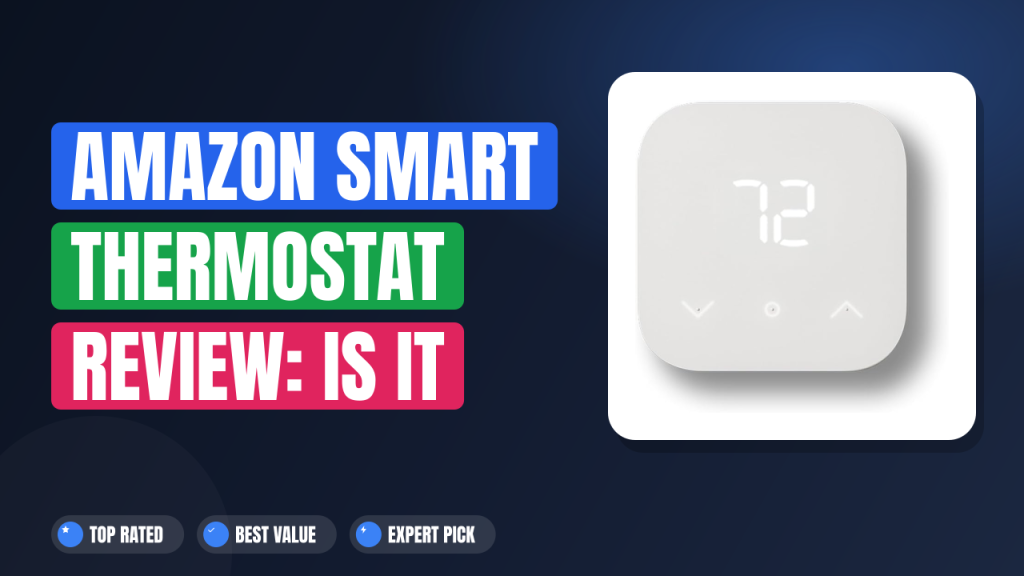
When we started comparing budget smart thermostats for a relative's 1970s ranch house, the Amazon Smart Thermostat kept surfacing on every shortlist. It's the least expensive way into a name-brand smart thermostat, and it's built on hardware from the same engineering team behind Honeywell Home controls. The question we wanted answered was simple: does the low price show up in daily use, or only on the receipt?
Short answer: buy it if your home already runs on Alexa and you have a C-wire behind the old thermostat. Skip it if you want room sensors, Google Home as your main app, or a unit that runs without a common wire. Here's what our spec comparison and thousands of buyer reports actually show.

1. Amazon Smart Thermostat
In our research, the Amazon Smart Thermostat came out as the strongest value pick for Alexa households that already have a C-wire. It gives up room sensors and platform flexibility, and in exchange it delivers dependable schedules, voice control and energy reporting for far less than premium models ask.
What it is
Amazon Smart Thermostat is a 24-volt programmable thermostat that connects to your home Wi-Fi and is controlled mainly through the Alexa app. Amazon builds it with Resideo, the company behind Honeywell Home controls, which is why the terminal labels and mounting plate feel familiar to anyone who has installed a T5 or T6.
As of 2026 it's still the cheapest Alexa-native thermostat Amazon sells, and it's positioned as the simple option: schedules, app control, voice commands, no subscription. Nest, Ecobee and Honeywell Home all compete in the same bracket, but each nudges you toward its own platform or a paid comfort feature. If you want one central controller for the rest of the house, that's a separate purchase.
Setup & first impressions
A C-wire is the single line that decides whether this install takes twenty minutes or two hours.
Per Amazon's installation documentation, the thermostat draws power from the C-wire, so there's no battery tray and no low-battery chirp at 2 a.m. Verified buyer reviews across thousands of ratings report the physical swap takes 20 to 30 minutes when a common wire is already at the wall plate. The kit includes wire labels, and the Alexa app walks you through each terminal with photos, which is the part nervous first-timers mention most often.
If your bundle has no spare conductor, Amazon sells a separate C-wire power adapter that mounts at the furnace control board. That's where reviews split. It's a quick job for anyone comfortable at the air handler and a call to an HVAC tech for everyone else.
Out of the box, buyers describe a plain white plastic body with a matte finish, a compact touchscreen and a wall plate that stays put while you clip the main unit on. Nothing feels premium, and nothing feels cheap either.
| Model | Amazon Smart Thermostat (B08J4C8871) |
| Power source | 24VAC C-wire required, no battery compartment |
| Connectivity | 2.4 GHz Wi-Fi only |
| Controls | Alexa app on iOS and Android, touchscreen on unit |
| Voice | Works with Alexa, no built-in microphone |
| HVAC support | Most 24V systems, up to 2-stage conventional heat and cool, plus heat pumps with aux heat |
| Not compatible with | Line-voltage 120V or 240V baseboard and wall heaters |
| Smart home | Alexa and Ring natively, Matter added by firmware update |
| Certification | ENERGY STAR certified |
| Warranty | 1-year limited |
Daily-use experience
Scheduling and the app
Schedules live in the Alexa app, not on the thermostat, so you'll edit them on a phone.
Once it's on the wall, the thermostat mostly runs itself. You build four periods per day (Wake, Away, Home, Sleep) inside the app, and the wall unit shows current temperature with a dial-style touch control for manual overrides. Buyer reviews consistently call the app the fastest part of the experience, especially in homes where Alexa already handles lights and locks.
You can say "set the hallway to 68" and it just happens.
The catch is that anyone in the house who avoids the Alexa app has no easy way in. There's no web portal and no local API for tinkerers. If you want other devices to follow the same schedule logic, plugs that speak the same language can be grouped into the same Alexa routines.
Energy savings and Hunches
Amazon Smart Thermostat is ENERGY STAR certified, and the ENERGY STAR program sets the efficiency bar a certified thermostat has to clear before it earns the label.
The bigger draw day to day is Alexa Hunches. It watches your patterns, suggests an eco adjustment when the house looks empty, and asks before it acts. The app also reports runtime hours per day, so you can see whether a schedule change actually cut heating time.
No independent test has published a fixed savings figure for this model, and no thermostat can promise one, because savings depend on your climate, insulation and equipment. Treat the runtime graph as feedback, not a guarantee.
Comfort, sensors and limits
This is the section where the price shows.
Amazon Smart Thermostat has no remote room sensors and no occupancy sensor, so it only knows the temperature at the wall where it's mounted. If your hallway is warm and the upstairs bedrooms run cold, the thermostat will hold the hallway and ignore the bedrooms all winter. Ecobee and Nest both sell sensor bundles that solve exactly that problem.
You can work around it with schedules and manual holds, and plenty of buyers do. But if uneven temperatures are your main complaint, this isn't the tool. Adding indoor air readings from a separate monitor tells you what's really happening room by room, and a quieter bedroom setup handles dust and stale air that a thermostat can't touch.
Build quality and reliability
The relay inside clicks audibly when the system engages, which is normal behavior for 24-volt thermostats.
Physically, it's a sealed white plastic shell with a glass-front touchscreen, and the mounting plate uses standard screw spacing that lines up with most existing wall boxes. Long-term buyer feedback focuses more on Wi-Fi than hardware. A small share of reviewers report needing to re-pair after a router change, and the fix is usually a stable 2.4 GHz signal at the wall.
That's worth checking before you buy, and your Wi-Fi reach matters more than the thermostat's own radio.
The one-year limited warranty covers manufacturing defects, not installation damage from miswiring. Photograph your old wiring before you pull it off the wall.
✓ Pros
- C-wire powered, so there are no AA batteries to swap every year
- ENERGY STAR certified with runtime-hour reporting in the app, which turns guesswork into visible feedback
- Schedules and Alexa Hunches work without a subscription, unlike paid eco tiers on some rivals
- 2.4 GHz Wi-Fi radio holds a stable connection in most homes once it’s paired correctly
- Two-piece mount keeps the wall plate in place while you wire, then the body clips on with no tools
✗ Cons
- No remote room sensors, so upstairs bedrooms drift while the hallway holds setpoint
- C-wire requirement rules out older homes without a spare conductor unless you buy the adapter
- No onboard microphone, so you can’t speak to the thermostat directly
- Display is small and plain, with no weather, humidity graph or air quality readout
Who should buy it
Buy it if you…
You own a house or apartment with a C-wire, a furnace or central air unit, and at least one Echo speaker. This is the natural pick for a first smart thermostat in a starter home, a rental where you can swap the original unit back before move-out, or a garage apartment on its own HVAC system.
It also slots neatly into the rest of the house if you're building things out room by room, because everything stays inside one app and one voice assistant. If you already pay for nothing else smart home related, this keeps the monthly bill at zero.
Skip it if you…
Skip it if Google Home or Apple Home is your primary app, if you need room sensors for a two-story house with a hot upstairs, or if your home runs on line-voltage baseboard heaters that no low-voltage thermostat can switch.
Skip it too if there's no C-wire and you have no interest in opening the furnace panel, because the adapter route isn't for everyone. And if you want a thermostat with its own built-in voice assistant, you're shopping in a completely different tier.
Better alternatives
- Google Nest Thermostat (2020): works natively with Google Home, has a distinctive mirrored dial, and sits in a similar value bracket.
- Ecobee Smart Thermostat Enhanced: supports remote SmartSensors for uneven rooms, and some bundles include one in the box.
- Honeywell Home T9: room sensors plus dual-platform support for both Alexa and Google, if you'd rather not commit to one ecosystem.
Frequently Asked Questions (FAQ)
Does the Amazon Smart Thermostat work without a C-wire?
No. It needs a C-wire or a separate power adapter, because there's no battery compartment inside the unit. Amazon sells an adapter that installs at the HVAC control board, and some homes have a spare unused conductor tucked behind the wall plate that can be repurposed.
Check what's actually there before ordering, since a thermostat that can't power on is a return waiting to happen.
Will it work with Google Home or Apple Home?
Amazon has pushed Matter support to the thermostat through firmware, which in theory lets it appear in other Matter controllers, but buyer reports suggest the experience is smoothest inside Alexa. Native integrations are Alexa and Ring. If Google Home is your main hub, the Nest Thermostat is a cleaner fit from the start, and a Matter-capable hub helps if you want everything under one roof.
How long does installation actually take?
Verified buyers report 20 to 30 minutes when a C-wire is already present, and an hour or more when a wire has to be run or adapted at the furnace. The app labels each terminal and shows photos of the wiring plate, which is why first-timers rate it easier than expected. Turn off the furnace breaker first, and photograph the old wiring before you disconnect anything.
Does it actually lower energy bills?
Savings depend on your climate, insulation and equipment, not on the thermostat brand. That said, certified models like this one are built to hold tighter schedulesand avoid heating an empty house. Aggregate buyer feedback points to the biggest gains coming from Away periods and Hunches, not from any magic algorithm.
The app's runtime graph lets you verify whether your own changes helped, which matters more than a marketing percentage. If you want a system that ties the whole house together, automation rules can trigger the thermostat alongside lights and locks.
Is it loud, and does the screen stay on?
The relay clicks audibly each time heating or cooling engages, which is normal for any 24-volt thermostat and not a defect. The display dims and sleeps when nobody is near, then wakes on touch, so it won't glow all night in a hallway. A small share of reviewers mention the wake sensitivity being a touch slow, but nothing that affects temperature control.
If you have a Ring doorbell, the thermostat also shows up as a device in the same app, which is handy for checking the house while you're traveling.
How does the warranty actually work?
Amazon covers manufacturing defects for one year from purchase, and claims go through Amazon customer service rather than a separate HVAC contractor network. Miswiring damage and normal wear aren't covered, which is why photographing your terminals before removal matters. Reviews on replacement units are mostly positive, with buyers reporting straightforward exchanges when a unit arrived dead on arrival.
Keep your order number handy, because that's the first thing support asks for.
Final verdict
4.5/5 for Alexa homes with a C-wire, and closer to 3.5/5 for anyone outside that setup.
If you're already living in the Alexa world and your wiring cooperates, this is the smart thermostat to buy. It handles schedules, voice control and energy reporting without asking for a subscription, and it costs far less than the premium names. That combination is hard to beat.
Skip it if room sensors, Google Home or line-voltage heating describe your house. Those aren't small quirks, they're the wrong tool for the job. Buy the Ecobee or Nest instead and you'll be happier.
One last practical note: verify the wiring before you order, keep the breaker off during install, and let the first week of runtime data tell you whether your schedule is actually working. The thermostat can only optimize what you tell it to.
Affiliate disclosure: This post contains affiliate links. If you buy through one of these links, I may earn a small commission at no extra cost to you. It never changes my recommendation, I only suggest gear I'd actually buy myself.

