
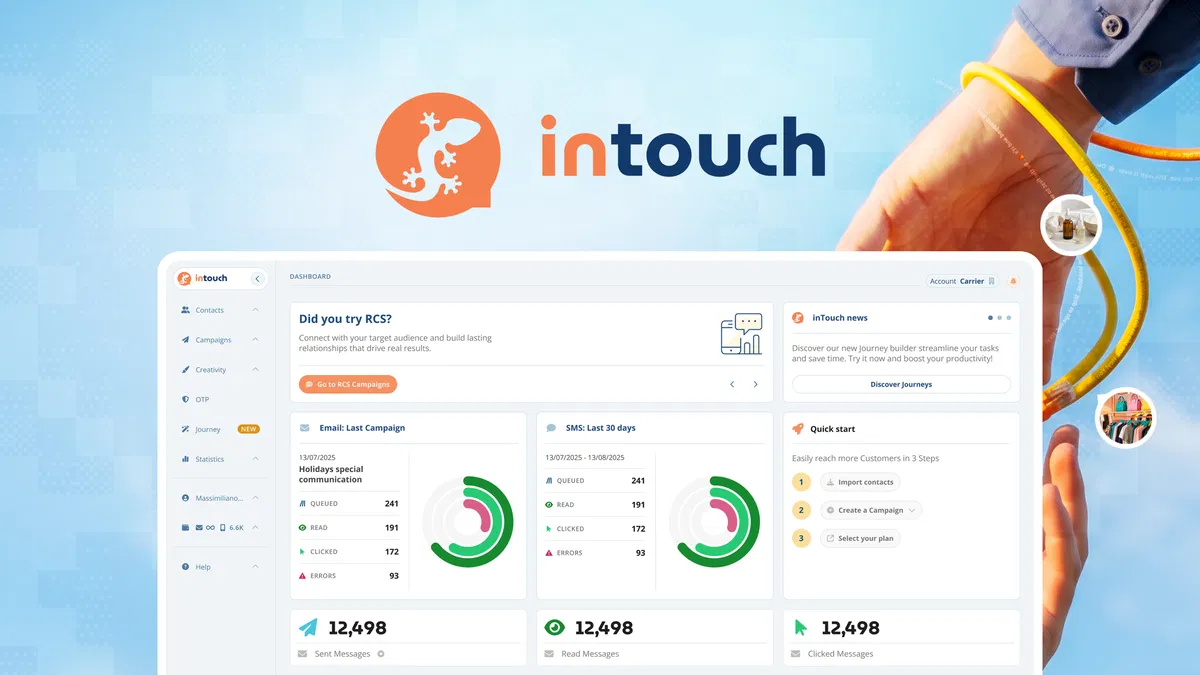
inTouch is an AppSumo lifetime deal that puts email, SMS, and RCS inside one account, and that three-channel mix is the part most budget email tools still skip. For $49 paid once, you get 10,000 emails a month plus 200 mobile credits, which changes the math for anyone currently paying monthly for two separate platforms.
Disclosure: This article contains affiliate links. We may earn a small commission at no extra cost to you when you sign up via our links, it's how this site stays free to run.
TL;DR Verdict
- Who it's for: Small ecommerce stores, agencies, and marketing teams that want email plus mobile messaging managed from one dashboard.
- Headline price: $49 lifetime for Tier 1 (10,000 emails per month, 200 mobile credits), with a 60-day refund window.
- Biggest pro: RCS support sits next to email and SMS in the same builder, a combination you rarely see under $100.
- Biggest con: Mobile credits are one-time and capped at 10,000, so SMS-heavy senders will keep buying add-ons.
- Free trial status: No free tier. Instead, the AppSumo listing offers a refundable purchase for up to 60 days.
Bottom line: if your email tool and your SMS tool have never spoken to each other, Get the Lifetime Deal → and run the numbers against your current monthly spend.
What Is inTouch?
inTouch is a multichannel messaging platform from rdcom.com that handles email campaigns, SMS, and RCS (rich communication services) from a single account. The company is based in Veneto, Italy, and its AppSumo listing carries a 4.50-star rating from 2 reviews.
The problem it solves is coordination. Most small teams run one tool for email and a different one for text messages, which means the same customer can receive a discount email and a nearly identical SMS within minutes. inTouch keeps contacts, opt-in status, and send history in one place so a coordinated sequence is a built feature rather than a lucky accident.
The second job is channel reach. Email works for newsletters and receipts, SMS works for time-sensitive nudges, and RCS adds rich cards with images and buttons on supported Android devices. Handling all three from one contact list means you can decide which channel fits each message without exporting CSVs between platforms.
Key Features That Matter
Drag-and-drop email builder with A/B testing
The editor supports text, images, buttons, video blocks, and dynamic content, so you can build a promotional email without touching HTML. A/B testing lets you send two subject lines or layouts to a slice of your list before the main send. The listing also includes a preview step and link check, which catches broken URLs before 10,000 people see them.
SMS and RCS in the same account
RCS cards carry media, call-to-action buttons, and dynamic fields, and inTouch walks you through building and previewing them inside the platform. For a retail brand, that means a product photo with a "Shop now" button instead of a plain text link. SMS stays available as the fallback for devices that don't support the richer format.
Multi-channel automated sequences
You build flows triggered by contact actions, events, or database conditions, then branch them with waits, splits, and conditional logic. A useful pattern: send an email, wait three days, check whether the link was clicked, then fire an SMS only to non-openers. Anyone who has set up trigger chains across connected gadgets will recognize the same if-this-then-that logic here, just pointed at customers instead of light switches.
Segmentation and unlimited contacts
Contact and list management are unlimited on every tier, and the segmentation tools let you slice audiences by behavior, location, or purchase history. That matters because pricing scales on emails sent, not on how many people sit in your database. You can keep dormant subscribers without paying a storage penalty.
Deliverability and pre-send validation
Anti-spam tools, deliverability checks, and message preview are bundled rather than sold as upgrades. The platform also has subscribe, unsubscribe, and preference-update flows with custom confirmation pages, which is the part compliance officers actually ask about. If you have ever wrestled with how preview cards render in a feed, you already know why the preview step matters before a big send.
Integrations and API access
inTouch connects through an API and webhooks, with Zapier for no-code automations and Salesforce listed among supported integrations. That opens the door to pushing order data from your store or syncing leads into a CRM. Webhook support means an order confirmation email can fire the moment your checkout system finishes a transaction.
Pricing Tiers (starts $49)
| Tier | Price | Best For | Free trial? |
|---|---|---|---|
| License Tier 1 | $49 one-time | Solo operators and small stores sending up to 10,000 emails/month | Refundable up to 60 days |
| License Tier 2 | $99 one-time | Growing shops at 22,000 emails/month with 400 mobile credits | Refundable up to 60 days |
| License Tier 3 | $199 one-time | Established ecommerce brands at 50,000 emails/month with 1,000 credits | Refundable up to 60 days |
| License Tier 4 | $429 one-time | High-volume senders at 100,000 emails/month with 2,000 credits | Refundable up to 60 days |
| Mobile credits add-on | $35 per 2,000 credits | Anyone who burns through the included SMS/RCS allowance | Non-refundable |
Every tier includes the full feature set: multi-channel messaging, marketing automations, campaign management, advanced segmentation, unlimited contacts, the drag-and-drop builder, lead generation forms, real-time analytics, A/B testing, and API access. The only differences are email volume and how many one-time mobile credits ship with your license. Those credits never expire, but they also never refill, and the add-on tops out at 10,000 total.
Compare that to a monthly email platform bill of $30 to $80 and Tier 1 pays for itself in a couple of months.
Pros and Cons
What Works Well
- Email, SMS, and RCS share one contact database and one interface.
- Lifetime pricing means no recurring subscription after the one-time payment.
- RCS cards with media and buttons open richer mobile messaging options.
- Unlimited contacts and lists remove the usual list-size pricing trap.
- A/B testing, link check, and previews are included rather than upsold.
- 60-day refund window gives you roughly two months to judge fit.
- API, webhooks, Zapier, and Salesforce cover most small-team integration needs.
Where It Falls Short
- Mobile credits are one-time and capped, so heavy SMS use gets expensive.
- No free plan, which makes testing harder for the cautious buyer.
- The AppSumo listing shows only 2 reviews, so social proof is thin.
- Analytics suit small teams better than enterprise reporting requirements.
- Phone and live chat support details are not spelled out on the listing.
- Migration from an established platform means rebuilding your automations.
Who Should Use inTouch?
Ecommerce stores sending 10,000 to 100,000 emails a month
If you sell physical products and rely on cart recovery plus order notifications, the email-plus-SMS pairing covers both jobs from one dashboard. Tier 2 or Tier 3 fits most stores at this size, and the segmentation tools let you separate buyers from browsers. The mobile credits stretch further when you reserve SMS for abandoned checkout rather than every promotion.
Small marketing teams and agencies
Agencies juggling several client accounts benefit from the flat lifetime cost, because per-seat subscriptions eat margin fast. Managing email, SMS, and RCS in one workspace also cuts the handoff errors that happen when copy lives in three tabs. Teams already comfortable with monthly spend tracking will find the volume-based pricing easy to project.
SMS-first service businesses
Appointment reminders, delivery windows, and booking confirmations are all natural SMS use cases, and RCS makes them look better on modern Android phones. Salons, clinics, and local service providers can run the whole flow without a separate texting tool. Email then handles the slower, longer-form communication.
Who should skip it: enterprises sending more than 100,000 emails a month, teams that need deep native CRM or helpdesk functionality inside the same tool, and anyone who will not accept a one-time mobile credit pool. If text messaging is your primary channel by volume, the add-on math will likely favor a dedicated SMS provider.
Alternatives to Consider
ActiveCampaign offers deeper CRM and sales automation depth, but its monthly pricing scales with contact count and it lacks RCS support in the same package. Klaviyo is built tightly around Shopify and ecommerce data, yet its costs climb quickly once your list grows past a few thousand profiles. Mailchimp remains the easiest starting point for pure email marketing, but SMS sits in a separate product and RCS is not part of the offer at all. inTouch wins on channel breadth and one-time cost; it loses on ecosystem depth.
Final Verdict
inTouch is a sensible buy for small ecommerce teams that want email, SMS, and RCS under one roof without stacking three subscriptions. The RCS features push it past typical budget email tools, and lifetime pricing from $49 makes the risk easy to measure against a 60-day refund window. The trade-off is the one-time mobile credit pool, which rewards careful use of SMS rather than constant blasting.
If unlimited contacts, multi-channel automations, and a single dashboard match how your team works, Get the Lifetime Deal → and test it against your current stack while the refund period is open.
Frequently Asked Questions
Does inTouch have a free plan?
No. The platform is sold as a one-time AppSumo license starting at $49, with no permanent free tier. The closest thing to a trial is the refund policy, which lets you request your money back within 60 days of purchase.
How does inTouch compare to Klaviyo?
Klaviyo goes deeper on ecommerce data and Shopify-native flows, and it is the stronger pick for large stores with complex attribution needs. inTouch counters with RCS support, SMS in the same account, and a one-time price instead of a monthly bill that grows with your list.
Can I cancel anytime?
There is no subscription to cancel because you pay once. What you can do is request a refund within the 60-day window through AppSumo, which makes the purchase effectively reversible for two months after checkout.
Is inTouch worth the price?
For a small team paying $30 to $80 every month for an email platform, Tier 1 at $49 pays for itself within one or two billing cycles. The value drops if you send a high volume of SMS, because credits are one-time and the add-on runs $35 per 2,000 credits.
Does inTouch support RCS messaging?
Yes, and that is its main differentiator. You can build interactive RCS cards with media, call-to-action buttons, and dynamic fields, then preview them through a guided flow inside the platform. SMS acts as the fallback for devices that cannot display the richer format, and both channels live in the same contact database as your email campaigns.
How do the mobile credits work?
Each tier includes a fixed one-time pool: 200, 400, 1,000, or 2,000 credits depending on the license. They do not expire, but they do not renew either, and the maximum purchase ceiling is 10,000 credits at $35 per 2,000. Budget your SMS and RCS sends accordingly, or keep a separate texting provider for high-volume months.

