
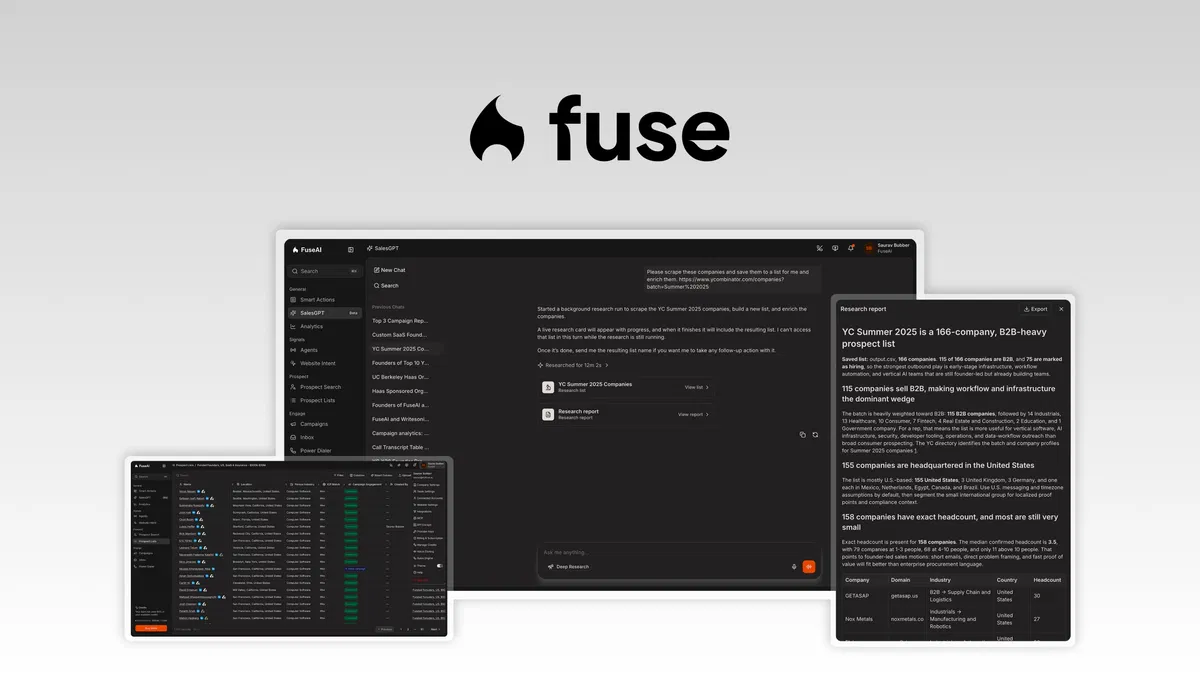
Fuse AI packs B2B prospecting, email and LinkedIn sequences, a parallel power dialer, and real-time buying signals into one agentic platform. The headline number is $89 for lifetime access on AppSumo, which is roughly what most outbound tools charge for a single month. This Fuse AI review separates the features that matter from the marketing copy, based on the vendor's own documentation, the AppSumo listing, and what third-party review platforms say about this category of tool.
Disclosure: This article contains affiliate links. We may earn a small commission at no extra cost to you when you sign up via our links. It's how this site stays free to run.
TL;DR Verdict
- Best for: sales managers and SMB teams running outbound across email, LinkedIn, and phone who want one login instead of four.
- Headline price: $89 one-time for License Tier 1 (1 seat, 1,000 credits per month), scaling to $799 for Tier 4 with 5 seats.
- Biggest pro: buying signals and waterfall enrichment sit inside the same tool that sends the sequence, so intent data turns into outreach without an export step.
- Biggest con: credits are the real currency here, and heavy LinkedIn automation plus AI research agents will burn through a low tier quickly.
- Trial status: no free plan, but every tier is refundable for up to 60 days under AppSumo's money-back guarantee.
- Bottom line: if you were about to pay monthly for a sequencer plus a data tool, Get the Lifetime Deal → is worth a serious look before the launch window closes.
What Is Fuse AI?
Fuse AI is an agentic outbound sales platform that combines prospect data, multi-channel sequencing, and buying signal tracking in a single workspace. It was founded in San Francisco and launched its AppSumo listing with a lifetime pricing model, targeting teams that currently stitch together a database, a sequencer, and a dialer.
The jobs it handles are the boring, repetitive ones. Finding contacts that match an ICP, verifying they are still at that company, drafting a message that references something real about them, then pushing that message through email or LinkedIn on a schedule. Fuse also runs a power dialer for the phone side of the motion, and logs call outcomes back to the same contact record.
The promise is fewer browser tabs and less stale data. Instead of exporting a list from a data provider, cleaning it in a spreadsheet, and uploading it into a sequencer, the enrichment, sequencing, and signal monitoring happen in one place. If you already run a connected sales and email stack, Fuse is designed to sit on top as the outbound layer rather than replace your CRM entirely.
Key Features That Matter
Multi-Channel Sequences Across Email and LinkedIn
Fuse builds sequences that run email and LinkedIn steps side by side, with AI-personalized copy that references prospect attributes you choose. The customization goes deep: the vendor's documentation lists examples like verifying SOC 2 compliance or checking whether a prospect plays golf. That level of personalization is aimed at reply rates, not volume.
The practical win is that a prospect who ignores three emails still gets a LinkedIn touch without you manually tracking who is where. Both channels report into the same contact timeline.
Built-In Power Dialer
The parallel power dialer skips dead numbers and unanswered lines, then surfaces live connections to the rep. Call dispositions and outcomes log directly into Fuse, so your pipeline record stays accurate without a second data entry pass.
You can attach dialer steps to an existing email and LinkedIn sequence. That turns three separate tools into one multi-channel motion, which matters most for teams of one to five reps who do not have an ops person to maintain integrations.
Real-Time Buying Signal Agents
You configure AI agents to watch for specific triggers: job changes, LinkedIn post engagement, and company website visits. Fuse then prioritizes those contacts inside the pipeline so outreach lands while the signal is still warm.
Website visitor identification is the piece most SMB teams cannot get elsewhere without a separate contract. It is also the feature that justifies the platform for companies with steady inbound traffic but no idea which accounts are actually browsing.
Smart Actions and Waterfall Enrichment
Smart Actions surfaces warm contacts and explains why each one matters right now, rather than handing you an undifferentiated list. Underneath, waterfall enrichment pulls B2B data from more than 20 providers in sequence, so a failed lookup at one source falls through to the next instead of returning a blank field.
That enrichment layer is the difference between a sequence that bounces and one that lands. If you have used a standalone data extraction tool before, you will recognize the value of chaining providers instead of trusting one database.
Deliverability and Email Warmup
Fuse includes email warmup and deliverability tooling to protect sender reputation, which is the feature that keeps your domain out of spam folders. For anyone running cold outbound at volume, this is not optional. It pairs with the consolidated inbox that self-organizes replies so nothing gets lost between threads.
Teams that have compared email platforms built for early teams will notice Fuse leans toward cold outbound rather than newsletter broadcasting. That distinction matters when you pick where to spend your budget.
Pricing Tiers (starts $89)
| Tier | Price | Best For | Free trial? |
|---|---|---|---|
| License Tier 1 | $89 one-time | Solo founders and single-rep outbound | No, 60-day refund window |
| License Tier 2 | $279 one-time | One rep running heavier volume (4,000 credits/month) | No, 60-day refund window |
| License Tier 3 | $499 one-time | Small teams, 3 seats, 10,000 credits/month | No, 60-day refund window |
| License Tier 4 | $799 one-time | Scaling teams, 5 seats, API and MCP access | No, 60-day refund window |
A note on how the credits work: each tier includes a one-time credit pool (60K, 250K, 500K, or 800K) plus a monthly credit allowance of 1,000 to 10,000 depending on tier. Only 50% of the one-time credits are available during the 60-day refund window, and the rest is released afterward. All four tiers include lifetime access to the Launch or Scale plan updates, and you must activate your license within 60 days of purchase.
The credits model is the single pricing detail worth reading twice before you buy.
Pros and Cons
Pros
- One login replaces separate prospecting, sequencing, and dialer subscriptions.
- Waterfall enrichment across 20+ providers reduces bounce rates on cold lists.
- Website visitor and job-change signals feed directly into outreach priority.
- Email warmup and deliverability tools come bundled, not sold as an add-on.
- Lifetime pricing at $89 undercuts a single month of most competing stacks.
- Bi-directional integrations cover Google, HubSpot, Salesforce, LinkedIn, and Slack.
Cons
- Credits run out fast if you lean hard on AI research agents and LinkedIn automation.
- The 60-day window only releases half your one-time credits, which limits early testing.
- Fuse was founded in late 2025, so there is no long track record to judge retention.
- No free plan, so you commit $89 before you can evaluate the interface properly.
- Phone support quality and dialer compliance rules are not documented in detail.
Who Should Use Fuse AI?
Solo Founders and Single-Rep Sales Teams
If you are the person finding leads, writing the emails, and making the calls, Fuse removes the handoff steps that eat your day. The Tier 1 license at $89 gives you one seat with email, LinkedIn, and dialing in a single window. It is a reasonable starting point for anyone whose outbound motion is still unproven and needs to stay cheap.
SMB Sales Managers Running 3 to 10 Reps
Tier 3 and Tier 4 make sense once you have multiple reps who each need their own sequence and their own pipeline view. Buying signals give a manager a defensible reason to redirect a rep's afternoon toward accounts showing real activity. That is harder to do when intent data lives in a separate dashboard nobody opens.
Agencies Running Outbound for Multiple Clients
Bi-directional CRM integrations plus 3 to 5 seats mean an agency can run distinct campaigns per client from one workspace. The constraint is credits, so agencies with high-volume clients should price Tier 4 before committing. If your team is still expanding your professional contacts manually on LinkedIn, the automation here replaces a lot of that manual work.
Who Should Skip It
Skip Fuse if your business runs on inbound marketing with almost no outbound prospecting, or if you need a full marketing automation suite with landing pages and lead scoring. Also skip it if you require a vendor with a five-year track record, because that is not what a late-2025 startup offers. And if credits confuse you more than per-seat pricing does, a predictable subscription may suit your bookkeeping better.
Alternatives to Consider
Apollo.io bundles a much larger contact database with sequencing, but its pricing is per-seat monthly and the data quality varies by region. Fuse trades database depth for signal-driven prioritization and a one-time fee.
Clay is the stronger choice if you want to build elaborate enrichment waterfalls and custom AI research workflows by hand. The trade-off is a steeper learning curve, and it does not ship a native power dialer.
Lemlist focuses on email and LinkedIn sequence quality with strong deliverability features, but you still need a separate data source and intent tool. Fuse covers those layers, though Lemlist's sequence editor is more mature for pure copy testing.
If you are weighing a broader stack decision, our breakdown of what to look for when choosing a pipeline system covers how these tools fit around your CRM. It is also worth scanning alternative bulk email options if newsletters matter as much as cold outbound.
Final Verdict
Fuse AI earns its place in the outbound conversation because it closes the loop between intent data and the message that goes out. The waterfall enrichment and buying signal agents are the two features that carry the product, and the $89 entry price makes testing them low-risk. The credits model and the company's short history are the real caveats, and neither is a dealbreaker at this price.
Aggregate reviews on platforms like G2 and Capterra consistently show that outbound teams value consolidation over feature depth, which is exactly the bet Fuse makes. If you want the full multi-channel motion without four subscriptions, Get the Lifetime Deal → while the AppSumo launch pricing is still live.
Frequently Asked Questions
Does Fuse AI have a free plan?
No. Fuse AI starts at $89 for License Tier 1, a one-time payment rather than a subscription. The safety net is the 60-day refund window, which effectively gives you two months to decide whether the platform fits your workflow.
How does Fuse AI compare to Apollo?
Apollo leads on database size and gives you a much larger contact pool out of the box. Fuse counters with waterfall enrichment across 20+ providers, website visitor signals, and a power dialer included at a one-time price instead of a monthly per-seat charge.
Can I cancel anytime?
There is no subscription to cancel. Your licenses are lifetime, so access continues as long as the vendor operates the platform. Refunds are available within 60 days of purchase, and you can downgrade tiers only within that same 60-day window.
Is Fuse AI worth the price?
At $89 for one seat with email, LinkedIn, dialing, enrichment, and warmup, the math works if you send even 200 cold emails a month. The value drops if you need very high volume, because higher credit tiers cost $279 to $799 and cap at 10,000 monthly credits.
What exactly counts as a credit in Fuse AI?
Credits are consumed by the AI-driven actions inside the platform, including enrichment lookups, research agents, and AI-drafted outreach. Each tier includes both a one-time credit pool and a monthly allowance, so plan your highest-consumption activities around those two limits.

