
AI coding agents keep burning your tokens by re-reading files they don't need. Vexp attacks that exact waste with a local dependency graph that serves only the code your agent actually requires, and it does so without a single network call. That combination of token savings and offline privacy is what separates it from most context tools on the market right now.
Disclosure: This article contains affiliate links. We may earn a small commission at no extra cost to you when you sign up via our links, and it's how this site stays free to run.
TL;DR Verdict
- Best for: Developers and small SaaS teams running Claude Code, Cursor, Codex, or similar agents on medium-to-large repos.
- Headline price: $49 one-time for Tier 1 (10,000 nodes, 1 seat, 1 repo) on AppSumo.
- Biggest pro: A fully offline dependency graph that keeps your source code on your machine while trimming wasted tokens.
- Biggest con: Node caps mean large monorepos jump to higher tiers quickly.
- Free trial: No free tier, but every license carries a 60-day money-back window.
- Bottom line: Get the Lifetime Deal →
What Is Vexp?
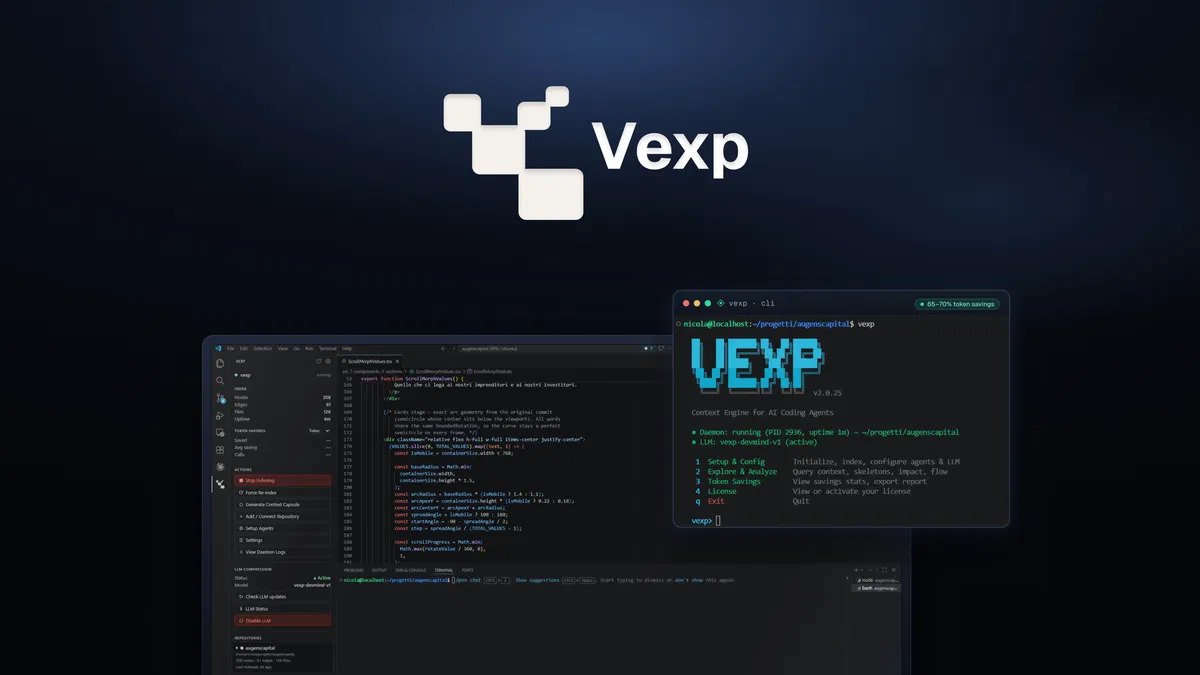
Vexp is a local-first context engine for AI coding agents. It parses your codebase into a dependency graph, then serves only the files, functions, and types a given prompt actually needs. Instead of dumping half your repository into a model's context window, Vexp returns a small capsule bound to your token budget.
The job it solves is specific. When you ask an AI agent to add one function, a default setup often re-reads dozens of unrelated files. That burns tokens, slows responses, and raises the odds the model picks the wrong import.
Vexp builds a map of how symbols depend on each other, then answers the agent's context request with the exact slice of code that matters. You can read the vendor's own breakdown on the official Vexp site.
Founded in Milan, Italy, in February 2026, Vexp is bootstrapped and small. That cuts two ways. You get founder-level attention on a young product.
You also accept a shorter track record. Aggregate ratings on the AppSumo listing sit at roughly 4.55 stars across 29 reviews, plus a Product Hunt presence, which is a small but positive sample.
If you have been comparing AI coding companions such as comparable AI coding tools, Vexp sits at a different layer. It isn't the agent. It's the context feed that any agent you already use can plug into.
Key Features That Matter
Local Dependency Graph Across 30+ Languages
Vexp uses tree-sitter indexing to parse functions, classes, and types into a graph. When an agent asks for context, Vexp walks that graph, traces call chains and import paths, and returns the minimal set of symbols. In practice, this is what stops an agent from reading 40 files to change one.
Eleven MCP Tools Through a Single Server
Vexp exposes a Model Context Protocol server that plugs into Claude Code, Codex, Cursor, Windsurf, and eight more agents. The 11 specialized tools cover context search, impact analysis, and logic tracing. You configure the agent once, and Vexp generates the MCP config for you.
The spec itself lives at the Model Context Protocol documentation.
Fully Offline, Zero Network Calls
All indexes live in a local SQLite file at .vexp/index.db inside your repo. Source code never leaves your machine, and secrets are filtered by default so credentials don't get pulled into a capsule. If you already treat encrypted network traffic as a baseline, this local-first design removes the cloud-leak worry entirely.
For teams weighing what stays on-device versus what goes to offsite data options, Vexp keeps the answer simple.
Session Memory and Stale Context Flags
Vexp remembers what your agent explored in earlier sessions. When code changes, it flags stale context automatically instead of silently serving outdated symbols. That one detail saves a surprising amount of debugging when you're switching between tasks or returning after a weekend.
Optional On-Device Model
A component called vexp-devmind preprocesses prompts locally using an on-device AI model. It compresses context before it reaches the cloud agent. You can leave it off, but if you want token savings with zero data leaving the machine, this is the mechanism behind the vendor's claim of up to 70% token reduction.
Expect some local compute overhead on modest hardware.
Cross-Repo Workspaces
You can add multiple repositories to one workspace for cross-repo queries. Git hooks keep the index in sync, and a shared workspace option on higher tiers lets teams reuse one index. That's the feature that makes microservice-heavy shops care about Vexp at all.
Pricing Tiers (starts $49)
| Tier | Price | Best For | Free trial? |
|---|---|---|---|
| Tier 1 | $49 one-time | Solo devs on one small-to-medium repo | 60-day refund |
| Tier 2 | $119 one-time | Solo devs with several repos needing more nodes | 60-day refund |
| Tier 3 | $199 one-time | Small teams (5 seats, unlimited repos) | 60-day refund |
| Tier 4 | $399 one-time | Larger teams (10 seats, every feature) | 60-day refund |
Each tier scales node capacity (10,000 / 50,000 / 100,000 / unlimited) and seats (1 / 1 / 5 / 10). Features like priority paths, analytics, intent detection, codelens, the LSP bridge, session memory, hybrid search, and the full 12-tool MCP set unlock progressively. All licenses are lifetime, and AppSumo backs them with a 60-day money-back guarantee.
There is no free trial in the usual SaaS sense. The lifetime license itself, paired with the 60-day refund window, is the trial. If Vexp doesn't cut your token usage or speed up your agent after a month of real work, the refund policy is straightforward and refundable.
Pros and Cons
Pros
- Runs entirely offline, so source code never touches a cloud index.
- Cuts wasted tokens by serving only dependency-relevant symbols to agents.
- Supports Claude Code, Codex, Cursor, Windsurf, and eight more via one MCP server.
- Lifetime license at $49 removes subscription fatigue common with AI tools.
- Auto-generated MCP config and git hooks keep setup to one guided command.
- Session memory and stale-context flags reduce re-exploration between tasks.
- Cross-repo queries on higher tiers help microservices and monorepo setups.
Cons
- Node caps on Tier 1 and 2 will frustrate very large monorepos.
- A 2026 launch means a short public track record and limited long-term data.
- Requires MCP support; agents without it can't use Vexp at all.
- The optional on-device model adds local compute overhead on weaker machines.
- Team features like shared workspace sit behind Tier 3 and up.
- Documentation depth is still catching up to the feature list.
Who Should Use Vexp?
Solo Developers on One or Two Repos
If you're paying per-token for Claude Code or Cursor and watching the bill climb, Vexp's local graph is the cheapest lever you can pull. Tier 1 at $49 covers 10,000 nodes, which handles a typical solo project. You also keep credential storage habits and code fully separated from cloud context.
Small SaaS Teams
A 5-seat Tier 3 license at $199 lets your team share one index and one workspace. Everyone's agent pulls consistent context, which trims the "works on my branch" class of bugs. For teams already evaluating AI productivity platforms, Vexp slots in underneath whichever agent you standardize on.
Microservices and Multi-Repo Shops
Unlimited repos per workspace (Tier 3 and up) let an agent trace a call into a service it doesn't live in. That is where dependency-aware context beats plain file search the most. If your team also leans on voice-first AI tools for meetings and notes, Vexp handles the coding side while those handle the rest.
Who Should Skip It
Skip Vexp if you work in a single small project under roughly 200 files, or if your agent doesn't speak MCP. Skip it if you can't tolerate node caps, or if you want a fully managed hosted index rather than a local SQLite file in your repo. Also skip it if you require a mature enterprise support org; this is a small bootstrapped team, not a Fortune 500 vendor.
Alternatives to Consider
Cursor's built-in indexing ships inside the editor and needs no extra setup. The trade-off is that its index is bound to Cursor, so you can't reuse it with Claude Code or Codex.
Sourcegraph Cody delivers enterprise-grade code search and context, but the pricing and deployment overhead are far heavier than a $49 lifetime license.
Repomix packs a whole repository into a single prompt file for any model. It's free and simple, but it doesn't build a dependency graph, so it can't guarantee that only the relevant symbols get sent.
Final Verdict
Vexp targets a real inefficiency: agents wasting tokens re-reading code they don't need. Its local dependency graph, offline design, and 11 MCP tools make it a genuinely useful layer for developers already leaning on AI coding agents. The $49 lifetime price is aggressive, and the 60-day refund removes most of the risk of trying it.
The main caveats are node caps, a short track record, and the hard requirement that your agent support MCP.
If your token bill or agent accuracy is a daily pain, this is one of the cheapest fixes available. Get the Lifetime Deal →
Frequently Asked Questions
Does Vexp have a free plan?
No. There is no free tier. The AppSumo lifetime license starts at $49 for Tier 1, and every purchase includes a 60-day money-back guarantee.
You can treat that refund window as an extended trial.
How does Vexp compare to Cursor's built-in indexing?
Cursor's index is bundled and requires zero setup, but it only works inside Cursor. Vexp runs as a standalone MCP server, so the same local graph feeds Claude Code, Codex, Cursor, and eight other agents. If you only use one editor, Cursor's built-in option is simpler.
If you switch agents, Vexp is more flexible.
Can I cancel anytime?
There's nothing to cancel. Vexp is sold as a one-time lifetime purchase through AppSumo, not a recurring subscription. You either keep the license or request a refund within the 60-day window.
Is Vexp worth the price?
For developers paying per-token on large repos, yes. If Vexp cuts token usage anywhere near the vendor's reported 70% figure, the $49 pays back within weeks. If your codebase is small or your agent doesn't support MCP, the value drops sharply.
Does Vexp work with my AI coding agent?
Vexp supports Claude Code, Codex, Cursor, Windsurf, and eight more agents through a single MCP server. If your agent supports the Model Context Protocol, Vexp can feed it context. If it doesn't, Vexp can't help, so check that first before buying.

