
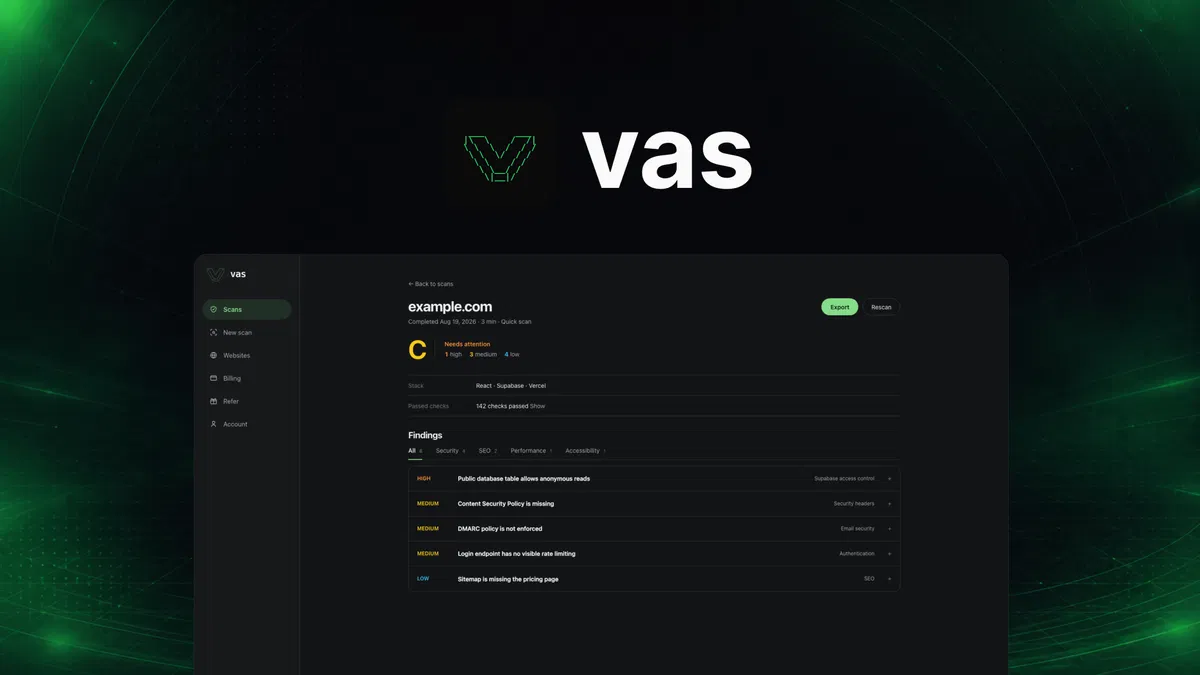
Vibe App Scanner scans a live, AI-built web app the way an attacker would, then hands you copy-paste fix code for every issue it finds. That last part is the differentiator. Most scanners stop at a red alert and a CVE number, while this one gives you remediation code you can drop straight into Lovable, Cursor, or Claude Code.
A lifetime AppSumo license starts at $49, roughly the cost of one hour with a security consultant.
Disclosure: This article contains affiliate links. We may earn a small commission at no extra cost to you when you sign up via our links, it's how this site stays free to run.
TL;DR Verdict
- Best for: solo developers, indie founders, and small agencies shipping AI-built apps on React, Supabase, Vercel, or Firebase.
- Price: $49 one-time for License Tier 1 on AppSumo (list price $240), with higher tiers at $119 and $249.
- Biggest pro: every finding arrives with copy-paste remediation code plus the raw JSON evidence behind the flag.
- Biggest con: only 3 AppSumo reviews so far, and the company launched in November 2025, so the track record is short.
- Free trial: none. You get lifetime access and a 60-day refund window instead.
Bottom line: if an AI tool wrote most of your app and nobody has stress-tested the auth flow, this is the cheapest way to learn what is exposed before a stranger does. Get the Lifetime Deal →
What Is Vibe App Scanner?
Vibe App Scanner is an external security scanner for live, AI-built web apps, and it tests what is actually exposed rather than what your code claims it does. You paste a URL, the scanner discovers your stack and endpoints, and it returns ranked findings with a fix attached. No repo access and no CI pipeline are required.
The job it handles is narrow and specific: closing the gap between "the app works" and "the app is safe to show paying customers." In practice that means catching service-role keys embedded in frontend bundles, Supabase tables anyone can read with the anon key, APIs that trust whatever user ID they are handed, and authentication that checks whether someone is logged in without checking what they are allowed to touch. Most people arriving here built their app with AI coding assistants that never asked a security question, which is exactly the gap that creates those bugs.
Founders Jacob Perks and a co-founder spent almost two decades in cybersecurity, running code and security audits through an agency, and the same four problems kept appearing in the apps clients brought them. Vibe App Scanner was founded on November 21, 2025, is based in Ontario, Canada, and runs as a bootstrapped team of under 10 people.
Here is the technical shape of it. The engine detects your stack out of the box across React, Supabase, Vercel and 20+ other platforms, then runs 150+ targeted checks against the running application, including inspection of your JavaScript, API discovery, database access-control tests, and authentication probes. The checks map to vulnerability classes tracked by OWASP, the nonprofit behind the Top 10 list of web application risks.
Integrations listed on the deal page cover Google Firebase, Stripe, and Supabase.
Key Features That Matter
URL-First Scanning With Stack Auto-Detection
Paste a live URL and the scanner fingerprints the platform underneath it, recognizing React, Supabase, Vercel and 20+ other stacks without configuration. That detection is not cosmetic. A Supabase anon key is designed to be public while a service-role key never is, and plenty of generic scanners flag both as one problem.
The founders say that distinction is a big reason they built their own check engine instead of reselling someone else's.
150+ Checks Tuned to AI-Generated Code
The check library targets the mistakes AI build tools repeat: exposed secrets, row-level security misconfigurations, missing security headers, permissive CORS, and endpoints that return far more data than the page needs. Each finding carries a label, so exposed secrets and RLS problems stay separated from low-priority noise. The access-control and authentication categories covered here line up with the baseline practices that NIST treats as table stakes for released software.
Authenticated Scans That Catch Access-Control Gaps
You can supply optional login credentials so the scanner tests pages behind the sign-in wall. That is where the expensive bugs live: the dashboard that loads another user's records when you change an ID in the URL, or the admin route any logged-in account can reach. Public-page scanning will never surface those, no matter how many checks it runs.
Severity Ranking With Plain-English Explanations
Every finding lands with a severity label, a short explanation of what an attacker could actually do with it, and the location it was found. You get a fix order rather than a wall of warnings. If performance is also on your list, the same scan reports on speed, which pairs well with a separate look at page load timings when something feels slow.
Copy-Paste Remediation Plus Raw JSON Evidence
Each issue ships with ready-to-paste remediation code you can hand to your AI tool or editor, so the fix happens in minutes instead of a research session. You can also open the raw JSON evidence behind any finding to see exactly what was tested and why it was flagged. That combination lets you verify the problem before you change a line of code, which matters when an AI writes the patch.
Progress Tracking, Automation, MCP and API Access
Every scan is stored, so you can watch your security score climb as you work through findings and compare results across deploys or environments. Weekly scan automation catches regressions after a push, and MCP plus API access lets your own tooling pull results in. The same run also reports on accessibility, SEO, compliance, email security, and AI search visibility, useful before launch if social share previews and indexation matter to you.
Pricing Tiers (starts $59)
| Tier | Price | Best For | Free trial? |
|---|---|---|---|
| License Tier 1 | $49 one-time (list $240) | Solo builders with 1 to 3 live apps | No, 60-day refund |
| License Tier 2 | $119 one-time | Freelancers and small studios, up to 10 sites | No, 60-day refund |
| License Tier 3 | $249 one-time | Agencies covering unlimited client sites | No, 60-day refund |
All three tiers are lifetime licenses, not subscriptions, and the feature list is identical across them: 15, 50, or 150 scans per month, 3, 10, or unlimited websites, plus weekly scan automation, email breach monitoring, MCP access, API access, full on-demand scanning, and copy-paste fixes for your AI tool. The standard entry price is $59, and the AppSumo launch drops Tier 1 to $49, which works out at under $4 per month across a single year. AppSumo applies a 60-day money-back guarantee, and Plus members get the platform's We Got Your Back guarantee on top.
One quirk is worth flagging: Tier 3 gives you unlimited websites but still caps you at 150 scans per month, so a large client portfolio running weekly automation will burn that quota quickly.
Pros and Cons
Pros
- Remediation code with every finding turns a scan into a real fix.
- Separates public Supabase anon keys from dangerous service-role keys.
- Authenticated scanning exposes broken access control on signed-in pages.
- Severity ranking pushes auth flaws and data leaks above cosmetic warnings.
- Raw JSON evidence makes each result auditable rather than a black box.
- Weekly automation plus API and MCP access suits teams that deploy often.
- One scan also covers performance, SEO, compliance, and email security.
Cons
- Only 3 AppSumo reviews at 4.67 stars, so social proof is thin.
- Tier 1 is tight: 15 scans a month across 3 websites.
- No free trial, so you evaluate inside the 60-day refund window.
- External testing cannot find logic flaws that need a code review.
- The company started in November 2025, so there is no long track record.
- Tier 3 caps scans at 150 even with unlimited websites attached.
Who Should Use Vibe App Scanner?
Solo Founders Shipping a First SaaS
You built the thing in a weekend, it works, and now real users are entering real data. Most solo founders generate that first version with AI build tools and then discover the exposed key or open table the hard way. This is the cheapest insurance you can bolt on before you start charging.
Freelancers and Small Studios Handing Over Client Apps
Agencies get blamed for security holes long after the invoice is paid. Running a scan before handover gives you a findings report and a fix trail, which is far easier to defend than a shrug. It also fits the same discipline you already apply when managing client relationships in a CRM.
Small Teams Without a Security Engineer
If your team is three developers and a designer, nobody owns security, and it shows up as an unpatched auth flow nobody wants to touch. Weekly scan automation gives you a standing check without hiring anyone. The plain-English explanations also mean a junior developer can act on a finding without a security background.
Who Should Skip It
Skip this if you already run SAST and DAST tooling inside a CI pipeline, or if a customer contract requires a signed penetration test report from a certified firm. Skip it if you need source-code analysis, because external scanning tests the deployed app, not the repository. And if your concern is encrypting your own connection while you work, external scanning and connection privacy are two different purchases.
Alternatives to Consider
OWASP ZAP is free, open source, and capable of deep manual testing, but it expects you to understand what you are doing and it will not hand you fix code tuned to AI-generated apps.
Snyk scans source code and dependencies for known vulnerabilities, which solves a different problem than probing a live URL for broken access control.
Burp Suite remains the industry standard for hands-on web testing, with a learning curve and price point aimed at security professionals rather than solo founders.
Final Verdict
Vibe App Scanner solves a problem that got much bigger the moment AI tools started shipping working apps in a weekend. It is not a full security program, and it will not find business-logic flaws buried in your code. But at $49 for a lifetime license with a 60-day refund window, the math is simple: one exposed service-role key costs more than the tool ever will.
If your app is live and nobody has tested the auth flow, run a scan this week. Get the Lifetime Deal →
Frequently Asked Questions
Does Vibe App Scanner have a free plan?
There is no free tier. The AppSumo deal is a one-time lifetime license, and the 60-day money-back guarantee acts as the closest thing to a trial. You can scan your own app within minutes of purchasing.
How does Vibe App Scanner compare to OWASP ZAP?
ZAP is free, open source, and built for people who enjoy configuring scanners and interpreting raw output. Vibe App Scanner is task-focused: paste a URL, get ranked findings with copy-paste fixes. ZAP wins on price and depth, VAS wins on time to a fixed vulnerability.
Can I cancel anytime?
There is nothing to cancel, because you are buying a license rather than starting a subscription. Refunds run through AppSumo inside the 60-day window. After that, the license is yours permanently, including the features listed for your tier.
Is Vibe App Scanner worth the price?
One leaked service-role key or an open Supabase table costs far more than $49 once a stranger finds it. Compared with a single freelance penetration test, the entry tier is a rounding error. If you ship with AI tools and never tested your auth flow, it pays for itself the first time it catches something real.
Does Vibe App Scanner test Supabase RLS policies and exposed API keys?
Yes. According to the AppSumo listing, the checks cover RLS misconfigurations, exposed secrets, and missing headers, and the founders specifically call out the difference between a public anon key and a private service-role key. The scanner tests database access controls against your live application rather than reading your schema on paper.

