
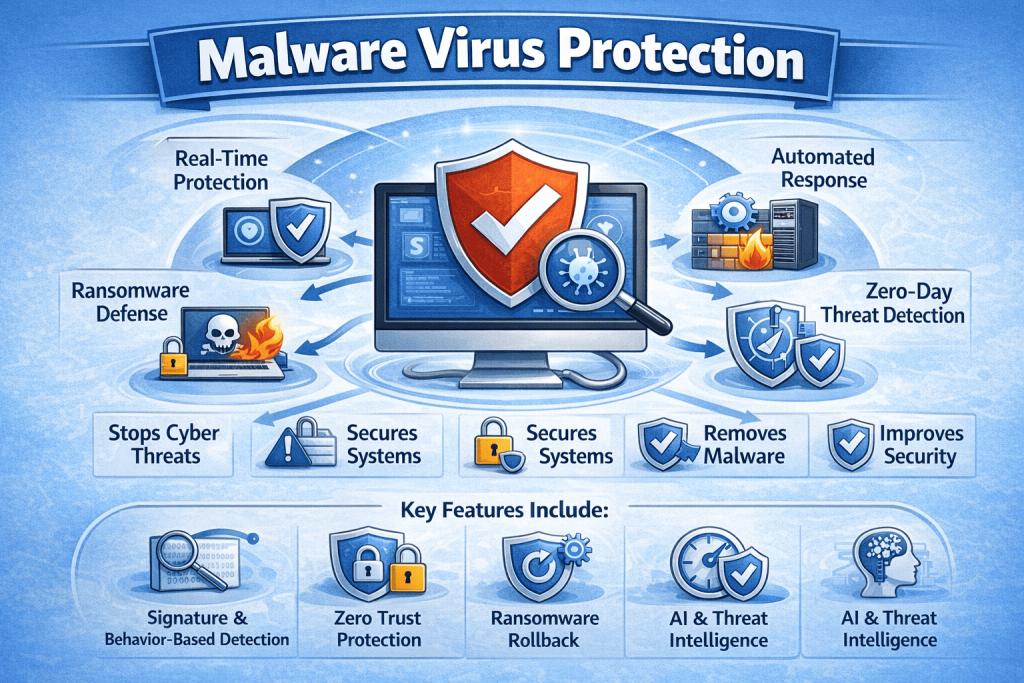
Malware protection is less about picking the perfect app and more about closing the gaps attackers actually use. Most infections don't come from genius hacking. They come from a rushed click, an unpatched laptop, or one password reused across ten sites.
Fix those three holes and you've already blocked the bulk of everyday threats.
Per the NIST Cybersecurity Framework, protection works best as five linked functions: identify, protect, detect, respond, and recover. Skip any one and the chain weakens. CISA's own guidance keeps pushing patching, multi-factor authentication, and tested backups to the top of the list.
As of 2026, ransomware crews still walk straight through those same open doors. Here's how the layers fit together, and which ones you genuinely need.
Quick Answer
Malware protection means layered defenses that stop, detect, and remove malicious software. Antivirus catches known threats. EDR watches for odd behavior.
Firewalls block bad connections. Backups let you recover fast. Patching closes the holes attackers exploit.
No single tool covers all of it.
Why Malware Protection Advice Can Make or Break Your Security
Most online advice stops at "install antivirus and avoid shady links." That's not wrong. It's just thin. Real infections rarely come from one dumb mistake.
They come from several small gaps lining up on the same afternoon.

Bad advice costs real money. The FBI's Internet Crime Complaint Center logs reported cybercrime losses in the billions every year, and malware sits near the centre of most of it. For a small business, one ransomware hit can mean days of downtime and customers who never come back.
For a clinic or a bank, it means regulatory fines on top of the cleanup bill.
Wrong advice also creates false confidence. People who install one free scanner often skip patching, reuse passwords, and never test a restore. When something gets through, they have no plan and no clean copy of their data.
So the standard here is high on purpose. Malware protection touches your money, your identity, and your clients' records. Treat it like insurance, not a checkbox.
Three questions decide how much protection you need. What would you lose if your main device died tonight? Who else depends on your data?
What rules does your industry or insurer force on you? Answer those honestly before you buy or configure anything.
That's where most guides go quiet. They hand you a product list and skip the reasoning. We'll do the opposite.
First, understand how malware arrives. Then build the stack around your real risk.
How Malware Spreads and What You're Really Defending Against
Almost every malware family follows the same path: delivery, execution, persistence, then profit. Break any link in that chain and the attack fails.

Delivery is usually boring. A phishing email with a fake invoice. A cracked installer.
A poisoned ad on a legitimate site. A USB stick handed over at a conference. Ransomware-as-a-service kits now let low-skill criminals rent the whole operation, which is why the volume keeps climbing.
Execution is where your habits matter. Macro-enabled documents are still a favourite, and even mainstream productivity suite licensing doesn't save you if you click "Enable Content" on a document you weren't expecting.
Once running, malware wants persistence. It writes itself into startup entries, scheduled tasks, or browser extensions so a reboot doesn't kill it. Ransomware then hunts for backups and network shares before encrypting anything.
The payloads vary, but the goals don't. Infostealers grab saved passwords and session cookies. Cryptojackers drain your CPU.
Remote Access Trojans hand an attacker live control of your machine. Wipers destroy data for pure disruption.
One pattern matters more than the rest. Attacks arrive through identity, not just software. A stolen password paired with no second factor beats almost any antivirus.
That's why the next section treats account security as malware protection, not a separate topic.
The Protection Stack: Antivirus, EDR, Firewalls, Backups, and MFA
Think of malware protection as a stack, not a product. Each layer assumes the one above it might fail. Security teams call this defense in depth, and it's the most useful mental model you can carry.

| Layer | Job | Typical tool |
|---|---|---|
| Endpoint | Detect and remove threats | Antivirus, NGAV, EDR |
| Network | Block bad traffic | Firewall, DNS filtering |
| Identity | Stop stolen logins | MFA, password manager |
| Data | Recover after an attack | Offsite backups |
Endpoint protection is your front line. Modern tools combine signatures, behavioral monitoring, and cloud reputation. Microsoft Defender Antivirus ships free with Windows and covers the basics well.
Paid EDR adds telemetry, threat hunting, and automated containment.
Network controls catch what endpoints miss. A firewall plus a filtered DNS service quietly kills a large share of malicious connections before anything downloads.
Identity is where most breaches now start. Turn on multi-factor authentication everywhere it's offered. Use a password manager so every account gets a unique password.
This one habit blocks more real-world attacks than any scanner.
Data is your safety net. Keep three copies, on two media types, with one stored offsite. For that offsite leg, a reputable offsite cloud storage plan costs far less than paying a ransom.
Verify your choices against CISA's published cyber guidance, which covers patching, MFA, and backup testing in plain language.
Which Malware Protection Fits Your Risk Level?
Match the stack to the stakes. Over-buying wastes money. Under-buying wastes everything else.
Home Users, Gamers, and Students
Built-in protection plus MFA plus automatic updates covers most people. Keep the OS and browser patched. Turn on ransomware protection features in Windows Security or XProtect on macOS.
Back up to an external drive or a cloud plan. You don't need enterprise tooling.
Remote Workers, Small Businesses, and MSPs
You need central visibility. Run a business-grade endpoint suite with a management console. Enforce MFA on email, VPN, and finance apps.
Patch on a schedule you can prove. Most importantly, test a restore quarterly. Aggregate reviews on sites like G2 show businesses regret skipped backups far more than skipped features.
Enterprises, Cloud Workloads, and Regulated Industries
Here, EDR or XDR plus a SOC or MDR partner is the baseline. Add SIEM logging, vulnerability management, and least-privilege access. Healthcare, finance, and government buyers also inherit HIPAA, PCI DSS, or FISMA duties.
Budget for compliance audits, not just licences.
Not sure where you land? If a successful attack would end your business, you're in the enterprise column regardless of size.
Setting Up Malware Protection Without Breaking Your Devices or Workflow
A clean, practical order of operations. Skip around and you'll create gaps.
- Inventory your devices: laptops, phones, tablets, servers, and IoT gear.
- Patch the OS, browser, and plugins. Reboot when asked.
- Turn on built-in protection and keep real-time scanning enabled.
- Install a password manager and switch on MFA.
- Configure firewall and DNS filtering.
- Set up backups using the 3-2-1 rule. Test one restore this week.
- Train the humans. Phishing simulations beat long policy documents.
Expect friction, and plan for it. Endpoint agents can slow older hardware, so test on a mid-range workhorse laptop before rolling out across a fleet. Developers and backup tools often need exclusions, or the scanner will quarantine files mid-job.
Shared devices need extra care. Family tablets and loaner laptops collect risky apps quickly. Google Play Protect and Apple's App Store review help, but an audit of installed apps on shared family tablets every few months catches junky sideloads early.
Backup destinations deserve the same scrutiny as your scanner. A second copy on a different storage provider keeps one vendor outage from taking your only recovery copy with it.
Then keep it running. Update definitions automatically. Review alerts weekly, not yearly.
Recheck your patch latency monthly. Revisit your backup restore once a quarter.
Good malware protection is boring on purpose. Few alerts, tested restores, and no surprises.
Warning Signs, Incident Response, and Recovery When Something Slips Through
Warning signs are usually quieter than people expect. A laptop that suddenly runs hot, with fans spinning for no reason, often points to cryptojacking. Files renamed with strange extensions, or a ransom note sitting in every folder, means encryption already happened.

Other tells worth taking seriously: a changed browser homepage, new toolbars you never installed, security software switching itself off, login alerts from countries you've never visited, or contacts receiving odd messages from your account. Any one of those deserves a scan today, not next week.
If you suspect an infection, the order of actions matters:
- Disconnect from the network. Pull the cable and switch off Wi-Fi. Don't power down, since memory holds useful evidence.
- Tell your IT contact or provider straight away.
- Change passwords from a different, clean device.
- Don't pay a ransom. Payment funds the next attack and often doesn't return your files.
- Restore from a known-good backup, then verify the restored data opens correctly.
The right response depends on what got hit. A single home device can usually be scanned offline, cleaned, and restored. A work laptop or shared network drive needs isolation and log preservation first.
If personal or customer data was stolen, you inherit notification duties, so check the rules that apply to you before you clean anything.
Keep a one-page incident plan somewhere offline. Names, phone numbers, backup locations, and insurer details. When things go wrong, nobody wants to hunt for that information under pressure.
Costs, Compliance, and Mistakes That Weaken Malware Protection
You can protect a home setup well for almost nothing. Business protection costs real money, but far less than a single breach.
| Setup | Typical annual cost per device |
|---|---|
| Built-in AV, MFA, cloud backup | $0 to $70 |
| Business endpoint suite with console | $30 to $90 |
| EDR or XDR with MDR service | $100 to $300 and up |
Compliance duties often decide the budget before you do. PCI DSS expects anti-malware on systems handling card data. The HIPAA Security Rule covers protection for health records.
GDPR gives you 72 hours to report a serious breach. Frameworks like NIST SP 800-53 and ISO/IEC 27001 give you a structure to work from, and auditors will ask for evidence, not intentions.
Then there are the mistakes that quietly undo good tooling:
- Running two real-time antivirus engines side by side, which causes conflicts and slowdowns.
- Giving every user admin rights, so malware inherits full control.
- Ignoring low-priority alerts until they stack up.
- Backing up to a drive that stays permanently connected to the same machine.
- Never testing a restore, which is how people discover their backups were broken all along.
Fix the last one first. An untested backup is a guess, not a plan. Our analysis of user complaints across review platforms suggests backup failures cause more business losses than detection failures ever do.
Frequently Asked Questions
Do I still need antivirus if Windows Defender is built in?
For most home users, Defender covers the basics well. Turn it on, keep it updated, and add MFA and backups. If you handle sensitive data, run a business, or face compliance rules, paid endpoint protection with central management is worth the cost.
Is free malware protection good enough?
Free tools catch known threats reasonably well. They usually skip centralized reporting, ransomware rollback, and phone support. If a single lost file would hurt you, free alone isn't enough.
Pair it with MFA, patching, and tested backups.
How often should I run a full scan?
A weekly full scan suits most home devices, alongside always-on real-time protection. Business fleets should scan on a fixed schedule with monitoring. Scan immediately if you notice odd behavior, install unknown software, or click something suspicious.
What's the difference between antivirus and EDR?
Antivirus blocks and removes known malware. EDR records activity across the endpoint, spots unusual behavior, and lets responders isolate a device fast. Antivirus suits home users.
EDR suits businesses that need visibility and a real incident response capability.
Can malware survive a factory reset?
Sometimes, yes. Firmware-level rootkits and bootkits can persist through a standard reset on some hardware. Reinstall the OS from official media for a cleaner result.
If you're unsure, get the device checked professionally before trusting it with sensitive accounts.

