Types of Machine Learning Algorithms: A Complete Beginner’s Guide
Founder & Lead SaaS Analyst at PCSaaS · Google Ads & Analytics Certified · SaaS Stack Architect · 500+ Software Tools Tested · 8+ years in B2B SaaS evaluation, AppSumo lifetime deal curation, performance marketing, and AI workflow automation
Discover the main types of Machine Learning Algorithms and how they help machines make smarter, data-driven decisions every day.
Whether you’re aiming to improve your projects, enhance your skills, or simply get a clear grasp of the topic, knowing these algorithms will give you a powerful edge. You’ll discover the main categories of machine learning, how they work, and why each one matters for real-world problems.
By the end, you’ll feel confident navigating the world of machine learning and ready to apply the right approach to your own challenges. Keep reading to explore the types of machine learning algorithms that can transform your data into meaningful insights.
Supervised Learning
Supervised learning is one of the most common types of machine learning. It trains models using labeled data, where each input has a known output. The goal is to teach the algorithm to predict the correct output for new, unseen data based on past examples.
This approach helps machines learn patterns and relationships between input features and target labels. It is widely used because it provides clear guidance during training, making it easier to evaluate model performance.
How It Works
Supervised learning starts with a dataset containing inputs and their correct outputs. The algorithm analyzes this data to find patterns. It creates a model that links inputs to outputs. After training, the model predicts outputs for new inputs. The accuracy depends on the quality and size of the labeled data. Errors are used to improve the model over time.
In practice, the biggest challenge is obtaining enough clean, consistent labels. A common mistake is to overfit on training data — using too many features or a very deep tree that memorizes noise rather than general patterns. Regularly testing on a hold-out set and applying cross-validation are essential steps to ensure your model performs well on unseen data. Many businesses turn to powerful AI SEO tools for small business that automate parts of this validation process, saving time while improving reliability.
Common Algorithms
Popular supervised learning algorithms include decision trees, which split data into branches based on features. Support vector machines separate data points using a clear margin. Random forests combine multiple decision trees for better accuracy. Linear regression predicts continuous values, while logistic regression classifies data into categories. Gradient boosting builds strong models by combining weak learners step-by-step.
Use Cases
Supervised learning is useful in many fields. In healthcare, it helps diagnose diseases from medical images. In finance, it detects fraudulent transactions. Email services use it to filter spam messages. Retailers apply it for sales forecasting and customer segmentation. It also powers voice recognition and language translation apps.
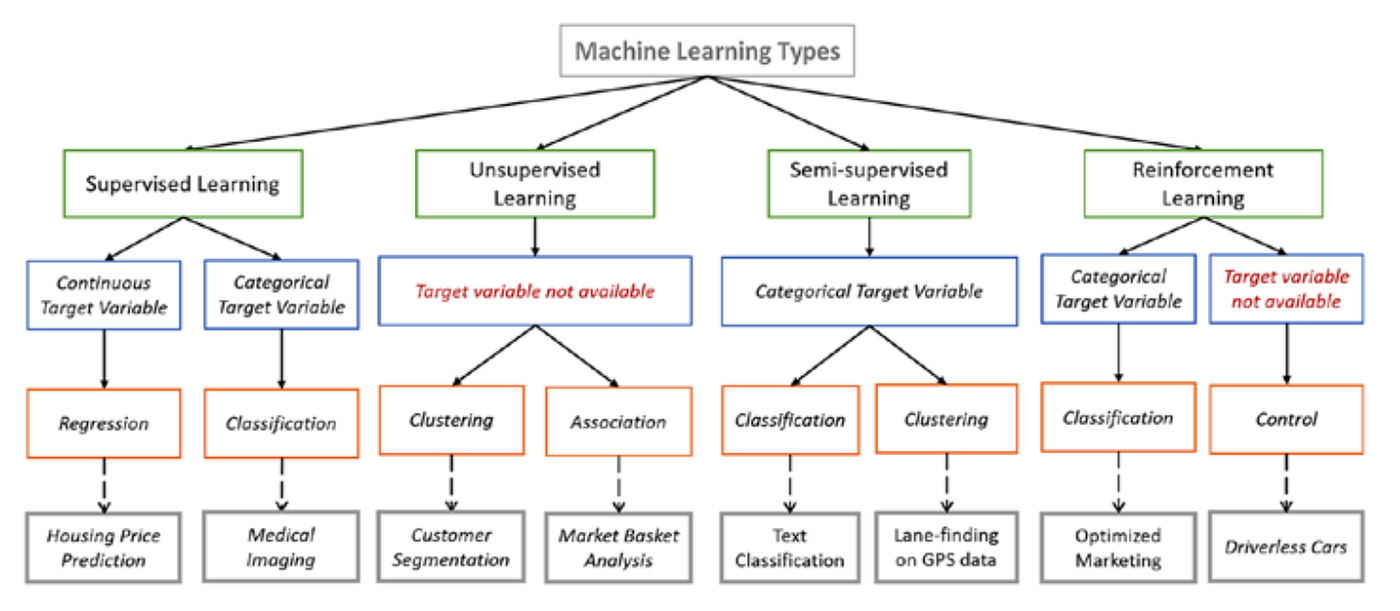 Diagram showing the typical workflow of a supervised learning algorithm from labeled inputs to prediction.
Credit: ai.plainenglish.io
Unsupervised Learning
Unsupervised learning is a key type of machine learning. It teaches machines to find patterns in data without labels. The system explores data on its own. It groups data or finds hidden structures. This learning type works well with unlabeled or raw data. It helps discover insights that are not obvious.
Core Concepts
Unsupervised learning finds hidden patterns in data. It does not use labeled outputs for training. The goal is to identify similarities or differences. Clustering and dimensionality reduction are common tasks. The algorithm organizes data into groups or reduces features. It uncovers the data's underlying structure.
A crucial point is that without labels, you must rely on domain knowledge to interpret the groups. For example, when performing customer segmentation, you might need to manually inspect cluster centers to assign meaningful labels like "high spenders." The algorithm will always find clusters — even if none exist naturally — so always validate with silhouette scores or elbow plots. For a deeper look at how these models integrate into real tools, check out AI video marketing tools that leverage unsupervised methods to recommend video content based on viewer behaviour.
Popular Models
K-means clustering is a widely used method. It groups data into clusters based on similarity. Hierarchical clustering builds nested clusters in a tree form. Principal Component Analysis (PCA) reduces data dimensions by summarizing features. Autoencoders are neural networks used for feature learning. Gaussian Mixture Models assume data comes from multiple normal distributions.
Practical Applications
Unsupervised learning helps in customer segmentation for marketing. It detects anomalies in fraud detection systems. It organizes large image collections by finding similar photos. Recommender systems use it to suggest products or content. It also helps in gene sequence analysis in biology. This learning type is vital for exploring unknown data.
Reinforcement Learning
Reinforcement learning is a type of machine learning where an agent learns by interacting with its environment. The agent takes actions and receives feedback in the form of rewards or penalties. This feedback helps the agent improve its decisions over time. The goal is to find the best strategy to maximize rewards.
This approach is different from other types of learning because it focuses on trial and error. The agent learns from the consequences of its actions rather than from a fixed dataset. Reinforcement learning is useful in situations where making a sequence of decisions is important.
Learning Process
The learning process in reinforcement learning involves three key elements: the agent, the environment, and the reward system. The agent observes the current state of the environment. It then selects an action based on a policy, which is a set of rules or a model.
After taking the action, the environment changes and provides a reward or penalty. The agent uses this feedback to update its policy. Over time, the agent learns which actions lead to better rewards and improves its strategy.
Designing the reward function is the most delicate part — it must encourage the desired behaviour without creating shortcuts. A common pitfall is rewarding the agent for intermediate steps that lead to undesired outcomes. For instance, a cleaning robot rewarded for covering area quickly might ignore obstacles. Balancing exploration (trying new actions) against exploitation (using known good actions) is another key tension. Libraries like TensorFlow provide built-in environments to practice these concepts safely.
Key Algorithms
Several algorithms are popular in reinforcement learning. Q-learning is a simple method that estimates the value of actions in different states. It helps the agent decide the best action to take.
Deep Q-Networks (DQN) combine Q-learning with deep neural networks to handle complex environments. Another key algorithm is Policy Gradient, which directly learns the policy to select actions.
Actor-Critic methods blend value-based and policy-based approaches for better performance. These algorithms help reinforcement learning work in various fields.
Real-world Examples
Reinforcement learning is used in robotics to teach machines how to perform tasks. Robots learn to navigate spaces or manipulate objects by trial and error.
In video games, reinforcement learning trains agents to play at human or superhuman levels. It helps improve game AI and create challenging opponents.
Self-driving cars use reinforcement learning to make decisions in real-time. The system learns to drive safely by maximizing rewards like smooth and safe driving.
Semi-supervised Learning
Semi-supervised learning blends the best of supervised and unsupervised learning. It uses a small amount of labeled data with a large amount of unlabeled data. This approach helps models learn better patterns and generalize well. It reduces the need for costly labeled data while still maintaining accuracy.
This type of learning is useful when labeling data is expensive or time-consuming. It leverages the structure in unlabeled data to improve model performance. Semi-supervised learning is popular in many real-world applications.
Hybrid Approach
Semi-supervised learning combines labeled and unlabeled data for training. It starts by learning from the labeled data. Then it uses the unlabeled data to refine and improve the model. The model discovers hidden patterns in unlabeled data, boosting accuracy. This hybrid approach balances human effort and machine learning power.
Algorithm Examples
Several algorithms support semi-supervised learning. One example is the Semi-Supervised Support Vector Machine (S3VM). It extends classic SVM to use unlabeled data. Another is Label Propagation, which spreads labels through a graph of data points. Self-training is a method where the model labels unlabeled data iteratively. These algorithms adapt well to various data types.
Typical Uses
Semi-supervised learning suits tasks with limited labeled data. It is common in text classification and speech recognition. Medical imaging benefits from it due to costly expert labels. Fraud detection uses it to find rare, suspicious activities. This learning type works well in natural language processing tasks. It helps build better models with fewer labeled examples.
Self-supervised Learning
Self-supervised learning is a growing area of machine learning. It uses data without explicit labels to learn useful patterns. This approach helps machines understand complex data by creating their own labels. It bridges the gap between supervised and unsupervised learning. Self-supervised models learn by predicting parts of the input from other parts. This method reduces the need for costly labeled data while still achieving strong performance.
Basic Idea
Self-supervised learning trains models using the data itself as a source of supervision. The model generates pseudo-labels from the input data. It then learns to predict these labels from other parts of the data. This creates a learning signal without manual annotation. The model improves by minimizing the difference between predictions and generated labels. This process helps it understand the structure and meaning of the data.
Notable Techniques
Contrastive learning is a popular self-supervised method. It teaches models to tell apart similar and different data points. Masked language modeling, used in NLP, predicts missing words in sentences. Another technique is autoencoding, where the model reconstructs input data from a compressed form. These methods help the model grasp complex patterns without labeled data. They have shown great results in image, text, and speech tasks.
Emerging Applications
Self-supervised learning is gaining traction in many fields. In natural language processing, it powers models like BERT and GPT. These models understand and generate human-like text. In computer vision, it helps improve image recognition and object detection. Robotics uses self-supervised learning for better control and decision-making. Medical imaging benefits by detecting diseases from unlabeled scans. The approach also supports speech recognition and recommendation systems.
The reinforcement learning cycle: agent, action, reward, and updated state in a loop.
Credit: gerege.com
Ensemble Learning Methods
While the article has covered individual algorithms, many modern systems combine multiple models to achieve higher accuracy than any single algorithm can deliver. Ensemble learning methods are a powerful extension worth understanding.
Bagging
Bagging (Bootstrap Aggregating) trains several models on random subsets of the data and averages their predictions. Random Forest is a classic example: it builds hundreds of decision trees and votes on the output. This reduces variance and helps avoid overfitting, especially with noisy datasets.
Boosting
Boosting trains models sequentially, each one correcting the errors of the previous. Gradient Boosting and AdaBoost are common. They often achieve top-tier results on structured data but require careful tuning of learning rate and tree depth to prevent overfitting.
Stacking
Stacking uses a meta-model that learns how to best combine predictions from several base models. It is flexible but can be computationally expensive and risks overfitting if the base models are too similar.
In practice, ensemble methods are widely used in competition-winning solutions and commercial applications. For example, many best SEO report tools rely on ensembles to aggregate signals across many features for more accurate ranking predictions. A common trade-off: ensembles improve accuracy but increase training time and model complexity, so they are best used when raw precision is critical.
Algorithm Selection Tips
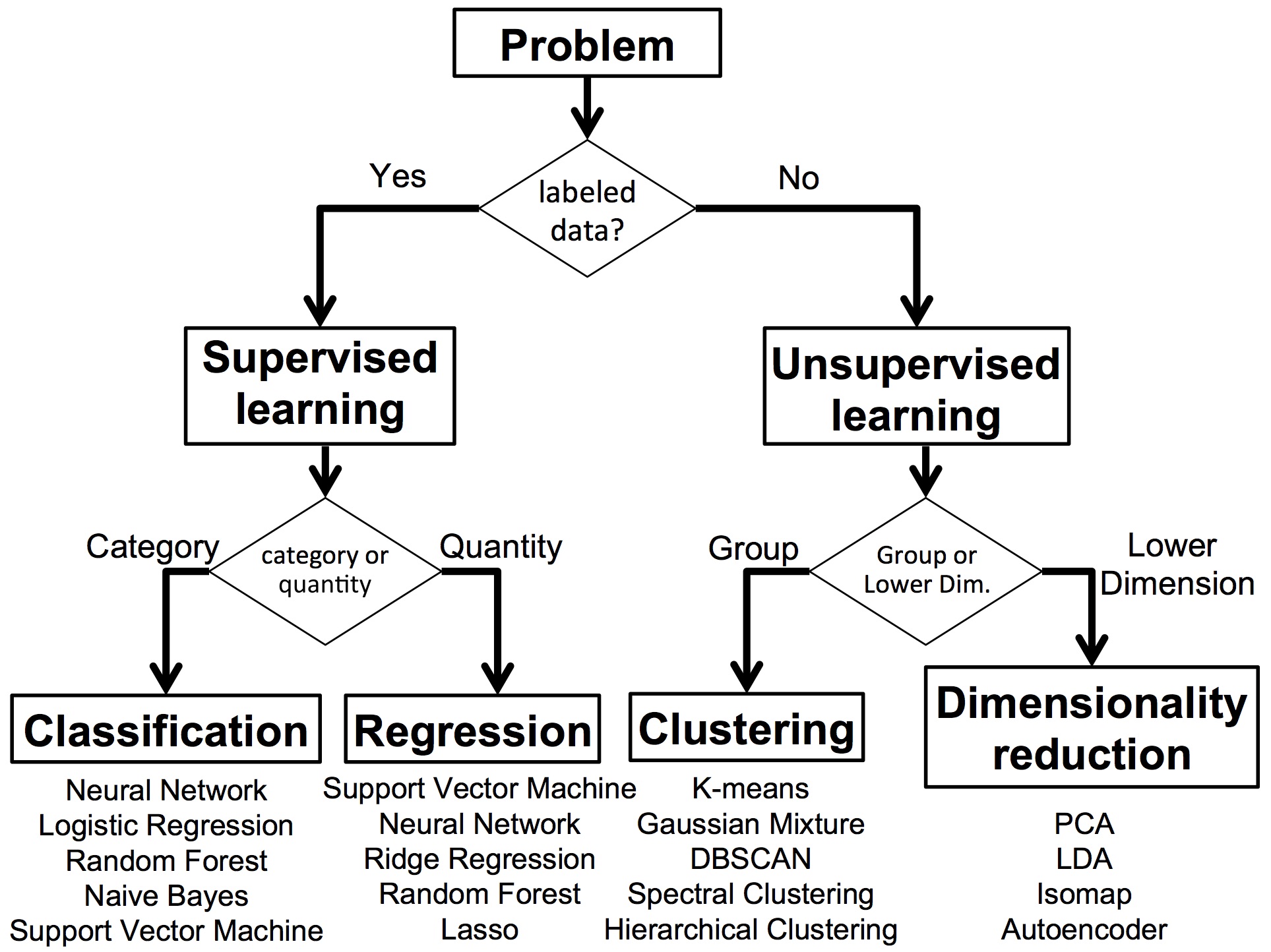
Selecting the right machine learning algorithm impacts your model's success. Several key factors guide this choice. Understanding these tips helps match algorithms to your needs. Focus on data, problem type, and performance for best results.
Data Considerations
Know the size and quality of your dataset. Large datasets may suit complex algorithms. Small datasets often need simpler models. Check if data is labeled or not. Labeled data fits supervised learning. Unlabeled data fits unsupervised learning. Clean data leads to better model accuracy. Remove errors and fill missing values first.
Problem Type Matching
Identify the task your model should solve. Classification problems need algorithms like decision trees. Regression tasks require linear regression or similar. Clustering problems use k-means or hierarchical methods. Choose algorithms designed for your problem type. This reduces trial and error in development.
Performance Factors
Consider speed and accuracy requirements. Some algorithms train faster but may be less accurate. Others take longer but give better results. Evaluate resource limits like memory and CPU. Complex models need more computing power. Balance performance with available resources for efficiency.
Common Pitfalls and Best Practices
Even after matching an algorithm to your problem, beginners often stumble on a few systematic issues. Overfitting is the most frequent — a model that performs perfectly on training data but fails on new data. Regularization techniques and simpler models often help. Underfitting, on the other hand, occurs when the model is too simple to capture underlying patterns; try increasing model complexity or adding engineered features.
Feature scaling is another hidden trap: algorithms like SVM, KNN, and neural networks assume all features are on a similar scale. Always normalize or standardize your inputs. Finally, document your experiments. Keeping a log of preprocessing steps, hyperparameters, and results will save you hours of debugging later. For teams scaling these practices, a white label SEO tool can help package reporting and analysis for clients without reinventing the wheel.
 Side-by-side illustration of the three main learning types: labeled data, unlabeled data, and agent-environment interaction.
Credit: gerege.com
Secure remote interviews with advanced AI detection – grab the Sherlock AI Lifetime Deal today.
Frequently Asked Questions
What Are The 7 Types Of Machine Learning?
The 7 types of machine learning are supervised, unsupervised, semi-supervised, self-supervised, reinforcement, deep learning, and online learning.
What Are The 5 Types Of Machine Learning?
The five types of machine learning are supervised, unsupervised, semi-supervised, self-supervised, and reinforcement learning. Supervised uses labeled data. Unsupervised finds patterns in unlabeled data. Semi-supervised combines labeled and unlabeled data. Self-supervised generates labels from data itself. Reinforcement learns via rewards.
What Are The Main 3 Types Of Ml Models?
The three main types of ML models are supervised learning, unsupervised learning, and reinforcement learning. Supervised learning uses labeled data to predict outcomes. Unsupervised learning finds patterns in unlabeled data. Reinforcement learning trains models through rewards and penalties based on actions.
What Are The Top 10 Machine Learning Algorithms?
The top 10 machine learning algorithms are Decision Trees, Random Forest, Support Vector Machines, Gradient Boosting, K-Means Clustering, Principal Component Analysis, Hierarchical Clustering, Gaussian Mixture Models, Naive Bayes, and k-Nearest Neighbors. These algorithms suit classification, regression, clustering, and dimensionality reduction tasks.
What is the difference between parametric and non-parametric models?
Parametric models assume a fixed form for the underlying data distribution — linear regression assumes a straight line, for example. They have a constant number of parameters regardless of dataset size. Non-parametric models (like k-Nearest Neighbors or decision trees) make fewer assumptions; their complexity grows with the data. The trade-off: parametric models are faster and need less data, while non-parametric models can capture more complex patterns but risk overfitting on small datasets.
Should I normalize my data before training an algorithm?
Yes, for distance-based and gradient-based algorithms (SVM, KNN, neural networks, PCA), feature scaling is essential. If one feature has much larger values (e.g., income in thousands) than another (e.g., age in years), the algorithm will give undue weight to the larger scale. Tree-based models (decision trees, random forest, gradient boosting) are generally unaffected by scaling, so it depends on your chosen method.
How do I choose between a deep learning model and a traditional ML model?
Deep learning excels when you have a massive amount of data (typically hundreds of thousands of examples or more) and complex unstructured inputs like images, audio, or text. For smaller tabular datasets (a few thousand rows with numeric/categorical features), traditional algorithms like random forest or gradient boosting often perform better and require less tuning — and they are easier to interpret. For a practical example of deep learning in action, see how Invideo AI video generator uses neural networks to turn scripts into dynamic videos.
Ready to put these concepts into practice? Discover how AI-powered tools can streamline your workflow — explore our curated list of AI video marketing tools to see machine learning in action.
Conclusion
Machine learning algorithms help computers learn from data. Different types fit different tasks and data types. Supervised learning uses labeled data to predict outcomes. Unsupervised learning finds patterns without labels. Reinforcement learning learns by trial and error with rewards. Choosing the right algorithm depends on your goal and data.
Understanding these types makes machine learning easier to use. Keep exploring to see which fits your needs best.

Similar Posts