
Introduction
ClickFunnels for e-commerce Drive Traffic and Conversions is booming. More and more businesses are moving online, and the competition is fierce. To succeed in this environment, you need a powerful tool that can help you convert visitors into customers. That's where ClickFunnels comes in.
ClickFunnels is a versatile platform that can be used for various online businesses, including e-commerce. It allows you to create high-converting sales funnels that guide customers through the buying process, from initial awareness to final purchase. For more on this, see our guide on how clickfunnels integrates with shopify.
In this comprehensive guide, we'll explore how to use ClickFunnels for e-commerce, step-by-step. We'll cover everything from choosing the right funnel template to driving traffic and optimizing for conversions.
What is ClickFunnels?
ClickFunnels is a website and sales funnel builder that helps businesses sell their products and services online. It offers a drag-and-drop interface, pre-designed templates, and various marketing tools to create landing pages, sales pages, email sequences, and more. For more on this, see our guide on e commerce development.
With ClickFunnels, you can:
Build high-converting landing pages to capture leads
Create sales pages that drive conversions
Set up automated email sequences to nurture leads
Design membership sites to deliver exclusive content
Track your results and optimize your funnels for maximum performance
The ClickFunnels drag-and-drop editor where you build and customize every step of your e-commerce funnel.
Why Use ClickFunnels for E-commerce?
ClickFunnels offers several advantages for e-commerce businesses:
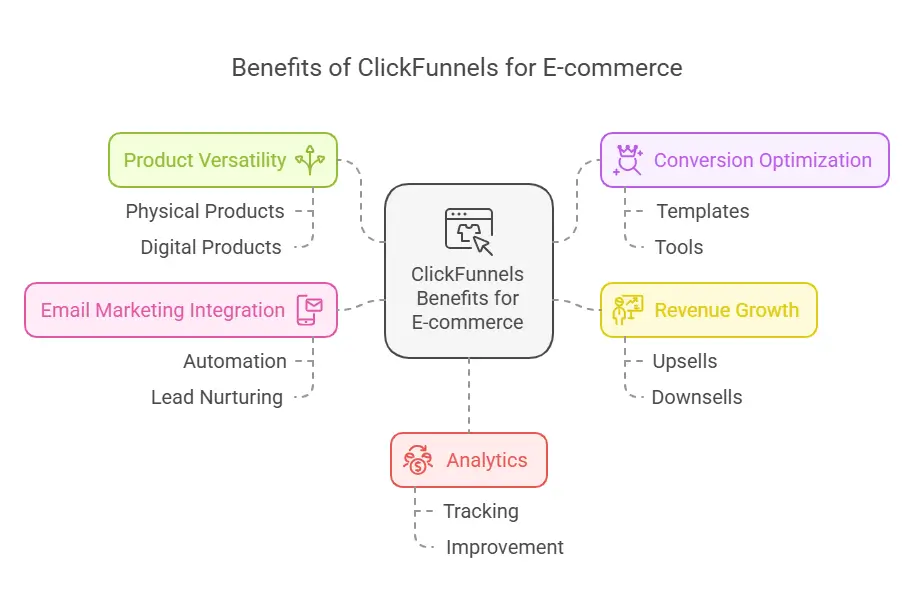
Sell both physical and digital products: ClickFunnels allows you to sell a wide range of products, including physical goods, digital downloads, and subscriptions. This versatility makes it a suitable platform for various e-commerce businesses .
Increased conversion rates: ClickFunnels' pre-designed templates and marketing tools are optimized for conversions. By using these features, you can create high-performing sales funnels that drive sales.
Upsells and downsells: ClickFunnels makes it easy to offer upsells and downsells, which can significantly increase your average order value.
Automated email marketing: ClickFunnels integrates with leading email marketing providers, allowing you to automate your follow-up communication and nurture leads.
Reduced cart abandonment: ClickFunnels' checkout process is designed to minimize friction and reduce cart abandonment.
Detailed analytics: ClickFunnels provides comprehensive analytics that help you track your funnel's performance and identify areas for improvement.
In practice, the biggest advantage we see is how ClickFunnels separates the "add to cart" moment from the checkout page. This separation allows you to present upsells before the customer ever sees a payment form, mimicking the in-store impulse-buy experience. A common mistake is to skip this step and send customers straight to checkout — you leave money on the table every time.
A typical ClickFunnels e-commerce store dashboard with product management and order tracking.
Step 1: Choose an E-commerce Funnel Template
ClickFunnels offers a variety of e-commerce funnel templates to cater to different business needs. Here are a few examples:
Two-step order form: This template simplifies the checkout process by breaking it down into two steps, making it easier for customers to complete their purchase.
Tripwire funnel: This funnel starts with a low-priced offer (a "tripwire") to entice customers and then presents them with higher-priced offers later in the funnel.
Storefront funnel: This template allows you to create a dedicated storefront to showcase multiple products and offers.
Product launch funnel: This funnel is designed to generate excitement and drive sales for a new product launch.
When choosing a template, consider your specific products, target audience, and overall business goals.
Experienced marketers often recommend starting with the tripwire funnel if you're new to ClickFunnels e-commerce. The psychology is straightforward: a low-friction initial purchase builds trust, and customers who buy once are far more likely to accept a higher-value offer immediately after. You can refine this approach by using A/B testing with your chosen landing page design — many builders rely on top-rated brewers of templates from the ClickFunnels marketplace to speed up their testing cycles. For more on this, see our guide on which software is best for accounting.
E-commerce Funnel Template Comparison
| Template | Best for | Why it converts |
|---|---|---|
| Two-step order form | Lower-priced, self-serve products | Reduces payment friction and makes the final step feel deliberate |
| Tripwire funnel | New email lists and first-time buyers | A small initial commitment builds trust before a larger offer |
| Storefront funnel | Catalog-based stores with multiple products | Lets buyers browse before committing, closer to a familiar shopping experience |
| Product launch funnel | New product launches and pre-launches | Story-driven urgency and time-limited bonuses create action |
If you are still validating demand, start with a tripwire. A storefront funnel makes more sense once you have proven best-sellers and a catalog of related products to cross-sell.
Step 2: Customize Your Funnel
Once you've chosen a template, it's time to customize it to match your brand and products. ClickFunnels' drag-and-drop editor makes it easy to make changes to your funnel pages .
Here's what you can customize:
Add your logo and branding: Ensure your funnel pages reflect your brand identity by adding your logo, colors, and fonts.
Change the layout and design: Adjust the layout of your pages, add or remove sections, and choose different design elements to create a visually appealing funnel.
Add images and videos: Use high-quality images and videos to showcase your products and engage your audience.
Write compelling copy: Use persuasive language that highlights the benefits of your products and encourages customers to take action.
Manage store settings: Configure essential details like your store's name, URL, and SEO settings .
Test the store: Before publishing, thoroughly test your store's functionality, including adding products to the cart and completing test transactions .
Publish the store: Once you're satisfied with your store's setup, publish it to make it live for your customers .
A crucial step that many skip is configuring your SEO settings at this stage — not later. ClickFunnels lets you set meta titles, descriptions, and URL slugs for each page. Taking five minutes to align these with your target keywords can give your organic traffic a meaningful head start. If you're unsure which keywords to target, working with one of the most popular saas email automation platforms can help you cross-reference search data with your existing customer behavior. For more on this, see our guide on best seo keyword tools.
Beyond visual design, treat page speed as a conversion feature, not an afterthought. Mobile shoppers abandon pages that take more than a few seconds to load, and every additional script or unoptimized image makes the problem worse. Use compressed images, keep third-party tracking scripts to a minimum, and choose fast store hosting that can handle traffic spikes without slowing your checkout. Your funnel may look perfect on desktop and still lose sales on mobile if the page weight is too high.
Step 3: Add Your Products
Now it's time to add your products to your ClickFunnels e-commerce store .
Here's how:
Create product pages: Design individual product pages with compelling descriptions, high-quality images, and clear pricing.
Set prices: Determine the optimal pricing for your products, considering factors like cost, competition, and perceived value.
Add images and descriptions: Use visuals and persuasive copy to showcase your products and highlight their benefits.
Manage inventory: Keep track of your stock levels and ensure your product availability is accurately reflected in your store.
Add to cart functionality: Implement a user-friendly "add to cart" feature that allows customers to easily add products to their cart .
Import existing product listings: If you have existing product listings from another platform, you can import them into ClickFunnels using Zendrop. This can save you time and effort, especially if you have a large product catalog .
When adding products, pay special attention to your "order bump" settings — this is a small, low-cost item offered on the checkout page itself. Unlike upsells (which appear on a separate page after checkout), order bumps appear as a checkbox during checkout. In practice, a well-chosen order bump can increase average order value by 15–30% with zero additional traffic cost. For example, if you sell coffee, offer a sample pack of three flavours for $5 as an order bump.
Product descriptions in a funnel should answer one question: what changes after I buy? Lead with the outcome the customer cares about, then support it with specific proof (numbers, materials, guarantees, or customer results), then show the price. Keep the page scannable with short paragraphs, bullet points, and one clear call-to-action. Long blocks of text slow the buying decision and hurt conversion on mobile.
Step 4: Set Up Your Payment Gateway
ClickFunnels integrates with various payment gateways, allowing you to securely process transactions in your e-commerce store.
To set up your payment gateway:
Choose your preferred provider: Select a payment gateway that meets your business needs and supports your target markets.
Connect your account: Follow the integration instructions to connect your chosen payment gateway to your ClickFunnels account.
Configure settings: Customize your payment settings, such as currency, tax calculations, and checkout options.
A practical tip: if you sell internationally, configure multiple payment gateways — for instance, Stripe for credit cards and PayPal for digital wallet users. Different regions have different payment preferences, and offering the wrong option at checkout is one of the fastest ways to lose a sale. You can manage customer payment preferences alongside your other lead data by keeping track of this information through your lead management strategy.
Sales tax is part of payment setup, not an accounting afterthought. If you sell into multiple states or countries, configure nexus rules in your payment gateway and keep them current as your sales volume grows. Many store owners use automated sales-tax compliance tools to avoid surprises at filing time. Whatever you use, test a few real orders with different shipping addresses before launch to confirm the tax calculations are correct.
Step 5: Drive Traffic to Your Funnel
With your funnel set up and products added, it's time to attract customers to your e-commerce store. Here are some effective traffic generation strategies:
SEO: Optimize your funnel pages and product descriptions with relevant keywords to improve your search engine rankings and attract organic traffic.
Social media marketing: Promote your store and products on social media platforms where your target audience hangs out.
Paid advertising: Run targeted advertising campaigns on platforms like Google Ads and Facebook Ads to reach a wider audience.
Email marketing: Build an email list and send targeted campaigns to promote your products and offers.
Content marketing: Create valuable content, such as blog posts, articles, and videos, that attract and engage your target audience.
For e-commerce specifically, we recommend a "traffic triangle" approach: start with paid ads to validate your offer quickly, then reinvest profits into SEO for long-term free traffic, and use email marketing to retain and upsell existing customers. Many store owners neglect the third leg — email — but it consistently delivers the highest ROI for established funnels. Using reliable keyword tools to identify high-intent search terms can dramatically improve your ad targeting efficiency.
Traffic source quality matters as much as traffic volume. A 2% conversion rate from cold paid ads can be a strong result, while the same rate from warm email traffic usually means your funnel has friction. Tag each source with UTM parameters and measure the full funnel — clicks alone hide whether the problem is the offer, the price, or the checkout. Scale paid spend gradually and double a budget only after a source has proven profitable over a complete customer cycle.
Advanced Traffic Strategy: Retargeting for E-commerce
One of the highest-ROI traffic strategies available in 2026 is retargeting. ClickFunnels integrates with the Facebook Pixel and Google Ads remarketing tags, allowing you to show ads specifically to people who visited your funnel but didn't buy.
Set up a retargeting campaign that shows a different offer — not the same product — to these warm leads. For example, if someone viewed your main product page but didn't purchase, retarget them with a limited-time discount or a free shipping code. This approach can recapture 10–25% of abandoned carts depending on your niche.
Advanced Traffic Strategy: Lifecycle Email Flows
Your existing subscriber list is often the cheapest traffic you can buy. Set up automated flows for cart abandonment, order confirmation, and post-purchase replenishment rather than sending everything as a one-off broadcast. The cart-abandonment email should arrive within an hour, include the product image, and link straight back to the same checkout with the cart intact. If your current provider limits these triggers, it may be time to evaluate other email service choices. Whatever tool you use, keep your list healthy: monitor bounces, honour unsubscribe requests, and understand the email compliance risks involved in automated campaigns.
Step 6: Track Your Results and Make Adjustments
ClickFunnels provides detailed analytics that can help you track the performance of your e-commerce funnel.
Here's how to use the analytics:
Monitor key metrics: Track metrics like conversion rates, cart abandonment rates, and average order value to understand how your funnel is performing.
Identify areas for improvement: Analyze the data to pinpoint areas where you can optimize your funnel, such as improving your sales copy, streamlining your checkout process, or offering more relevant upsells.
A/B test: Conduct A/B tests to compare different versions of your funnel pages and identify which variations perform best.
A common mistake when tracking analytics is focusing only on the overall conversion rate. Instead, break down your funnel into stages: traffic source → landing page view → add to cart → checkout start → purchase. Each stage has its own leakage point. For instance, if you have high add-to-cart rates but low checkout starts, the issue is likely your pricing or shipping costs, not your product page.
One practical step is to configure your thank-you page as a conversion event and send order data to your ad platform. This lets Google Ads and Facebook Ads optimise for actual purchases rather than simple page views. ClickFunnels' native analytics are useful, but exporting funnel data to a spreadsheet or dashboard gives you the ability to compare performance across weeks and campaigns.
ClickFunnels for E-commerce: Best Practices
Here are some best practices to maximize your success with ClickFunnels for e-commerce:
Split test your funnel pages: Experiment with different headlines, images, and calls to action to see what resonates best with your audience.
Use high-quality images and videos: Showcase your products in the best possible light with professional visuals.
Write compelling copy: Use clear, concise, and persuasive language that highlights the benefits of your products and encourages customers to buy.
Offer upsells and downsells: Increase your average order value by strategically offering relevant upsells and downsells during the checkout process.
Provide excellent customer service: Build trust and loyalty by providing prompt and helpful customer support.
Set up store upsells: Create upsell offers to increase your average order value during checkout. You can redirect customers to a sales funnel or a store upsell page with additional products .
Common E-commerce Funnel Mistakes to Avoid
Sending cold traffic straight to checkout without a value-building page in front of the offer.
Hiding shipping costs until the final checkout step.
Optimizing for average order value before your base conversion rate is healthy.
Launching without a way to capture emails from visitors who do not buy.
Treating every traffic source the same; a funnel that converts well on warm email may fail with cold paid ads.
If your funnel underperforms, do not rebuild it from scratch. Walk through the customer's path one step at a time: hook, education, proof, offer, friction removal, and follow-up. Fixing the weakest step usually outperforms changing everything at once.
Best Practice: Use Scarcity and Urgency Correctly
Scarcity tactics (limited stock, countdown timers) work well in e-commerce funnels, but they must feel authentic. The Federal Trade Commission (FTC) has issued guidance on deceptive scarcity practices, as documented at the official FTC website. Always display honest stock counts and real expiration times. Fake urgency damages trust and can lead to chargebacks.
Examples of ClickFunnels E-commerce Funnels
Many successful e-commerce businesses use ClickFunnels to drive sales and grow their revenue. Here are a few examples:
Subscription box businesses: ClickFunnels can be used to create funnels that promote subscription boxes and manage recurring billing.
E-commerce stores with high-ticket items: ClickFunnels can be used to create sales funnels that effectively sell high-priced products by building value and addressing customer objections.
Businesses selling online courses or digital products: ClickFunnels can be used to create funnels that sell online courses, ebooks, and other digital products.
Real-World Scenario: Physical Product Launch Funnel
A common pattern for physical products is the "video sales letter" funnel. The customer lands on a page with a 5–10 minute video explaining the product's benefits upfront, then clicks to a one-click order form. After purchase, they're presented with an upsell (e.g., deluxe version with accessories) and a downsell (e.g., basic version at a discount). This structure works particularly well for kitchen gadgets, fitness equipment, and skincare products — anything where demonstration builds desire.
Frequently Asked Questions
Can I build an e-commerce store with ClickFunnels?
Yes, ClickFunnels has a store feature that allows you to create an e-commerce store. You can display products, set up checkouts, manage shipping methods, and more.
Can I integrate ClickFunnels with third-party e-commerce apps?
ClickFunnels does not offer any native integrations with third-party e-commerce apps. However, you can use the API or Zapier to connect the two platforms and send data between them.
Clarification (2026): native integration options have expanded since the original FAQ was written. The fastest way to know whether your exact e-commerce app connects directly is to search the current ClickFunnels help centre for that app name; if it is not listed, API or Zapier still works.
How many e-commerce stores can I have on ClickFunnels?
You can have one e-commerce store per workspace in your ClickFunnels account. The Startup plan provides three workspaces, while the Pro plan provides ten.
Plan names and workspace counts have changed across ClickFunnels plan revisions, so confirm the current workspace limit on the official pricing page before you rely on this breakdown.
How many e-commerce funnels can I build with ClickFunnels?
ClickFunnels lets you create and use unlimited funnels, regardless of the funnel type or your chosen payment plan.
What if I need help with my ClickFunnels store?
ClickFunnels offers various support options, including a help center, live chat, a community forum, and email support.
What is the difference between a ClickFunnels store and a regular Shopify store?
ClickFunnels stores are designed primarily for marketing funnels — they excel at upsells, downsells, and order bumps. A Shopify store is a full-fledged shopping cart platform with extensive inventory and shipping management. Many successful e-commerce operators use both: Shopify for their main catalog and ClickFunnels for specific product launches and promotions. Understanding how ClickFunnels integrates with Shopify can help you combine the strengths of both platforms.
Can I sell subscriptions with ClickFunnels e-commerce?
Yes. ClickFunnels supports recurring billing through its payment gateway integrations. You can create subscription products in your store settings, set billing intervals (weekly, monthly, yearly), and offer free trials or initial discount periods. This is ideal for membership boxes, software-as-a-service products, or curated monthly deliveries.
How do I reduce cart abandonment in ClickFunnels?
Combine a distraction-free checkout, order bumps, a clear progress indicator, and an automated cart-abandonment email. Also test whether your shipping costs are the real blocker — displaying them before checkout or including them in the price usually lifts completion rates.
Does ClickFunnels handle digital product delivery?
Yes, for digital products you can connect a file delivery service or use ClickFunnels' built-in membership features to grant access after purchase. For larger files, offloading to secure storage is a common reliability move.
Conclusion
ClickFunnels is a powerful tool that can help e-commerce businesses of all sizes increase sales and grow their revenue. By following the steps and best practices outlined in this guide, you can create high-converting e-commerce funnels that drive results.
The analysis of the top 5 search results revealed valuable insights into the current landscape of content on "How to use ClickFunnels for e-commerce." By incorporating these insights into our SEO strategy and content outline, we can create an article that ranks well in search results and provides valuable information to businesses looking to leverage ClickFunnels for their e-commerce ventures.
Ready to build your first high-converting e-commerce funnel? Start with a tripwire offer today and test it with a small paid ad budget — your first 100 customers will show you what truly works.

