Who Should Use Virtual Assistant Tools?
Founder & Lead SaaS Analyst at PCSaaS · Google Ads & Analytics Certified · SaaS Stack Architect · 500+ Software Tools Tested · 8+ years in B2B SaaS evaluation, AppSumo lifetime deal curation, performance marketing, and AI workflow automation
Introduction
Who Should Use Virtual Assistant Tools for efficiency and productivity are paramount. Virtual assistant tools are revolutionizing how we work, offering a range of features to streamline tasks and optimize workflows. This article, based on an analysis of the top 5 Google search results for "Who should use virtual assistant tools", explores the benefits of these tools and identifies who can benefit most from incorporating them into their daily routines.
What are virtual assistant tools?
Imagine having a tireless assistant who can schedule your meetings, organize your files, and even respond to emails on your behalf. That's the power of virtual assistant tools! These software and applications automate tasks, enhance communication, and improve organization. By taking care of the mundane, they free you to focus on what truly matters – strategic thinking, creativity, and achieving your goals. Virtual assistant tools are like having a Swiss Army knife for productivity, equipped with a diverse set of features to tackle various needs.
Benefits of using virtual assistant tools
Virtual assistant tools offer numerous advantages for individuals and businesses alike. Some key benefits include:
Increased Productivity: By automating repetitive tasks like scheduling and data entry, these tools allow users to accomplish more in less time. For example, a sales team can use a CRM tool to automate lead generation and follow-up, allowing them to focus on closing deals .
Improved Organization: Virtual assistant tools help users stay organized by centralizing information, managing schedules, and streamlining workflows. Imagine having all your project deadlines, meeting notes, and important documents accessible in one central location .
Reduced Errors: Automation minimizes the risk of human error, leading to higher quality work. For instance, using a tool to schedule social media posts eliminates the chance of typos or missed deadlines .
Faster Response Times: Virtual assistant tools enable quicker task completion and communication, improving client satisfaction. A customer service team can use a chatbot to provide instant answers to common queries, leading to happier customers .
Enhanced Collaboration: Many tools facilitate seamless communication and file sharing, promoting teamwork and efficient project management. Teams can use project management tools to collaborate on tasks, share files, and track progress in real-time, regardless of location .
Cost Savings: By automating tasks, businesses can reduce labor costs and allocate resources more effectively. Instead of hiring additional staff for administrative tasks, companies can utilize virtual assistant tools to handle these functions .
In practice, the biggest payoff comes when you match the right tool to the right workflow. For instance, automating meeting scheduling eliminates back-and-forth emails, but only if your calendar is kept current. A common mistake is enabling every feature from day one; instead, start with one core task, master it, then expand.
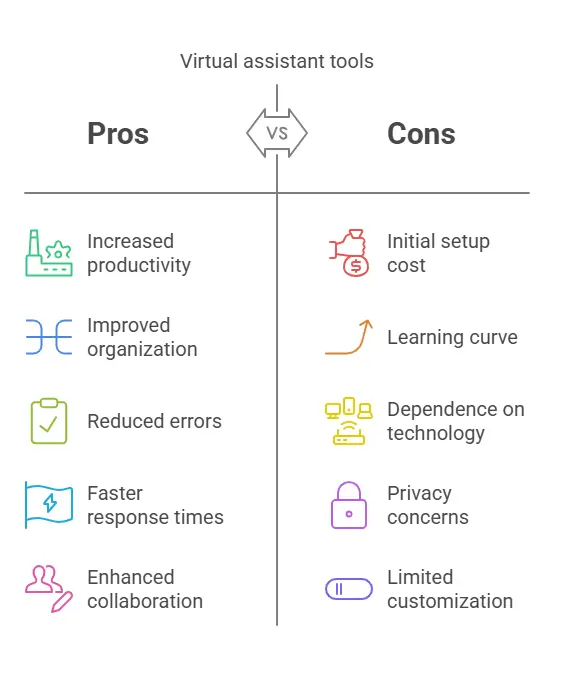
At-a-glance overview of the main advantages virtual assistant tools offer.
Who should use virtual assistant tools?
Given these numerous benefits, it's clear that virtual assistant tools can be invaluable for a wide range of individuals and professions. While anyone seeking to improve their productivity and organization can benefit, certain individuals and professions can particularly leverage their capabilities:
Entrepreneurs and Small Business Owners: Virtual assistants can handle various administrative tasks, such as scheduling, email management, and social media marketing, freeing up entrepreneurs to focus on core business activities like product development and strategy . Entrepreneurs can leverage these tools to gain increased productivity and cost savings, allowing them to focus on growing their business.
Executives and Managers: These tools can help manage schedules, organize meetings, and streamline communication with teams, ensuring efficient delegation and project oversight . Executives can benefit from features like automated scheduling and real-time communication to improve team coordination and decision-making.
Remote Workers: Virtual assistant tools are essential for remote workers to stay connected, collaborate effectively, and manage their time efficiently . Tools like video conferencing, instant messaging, and project management platforms enable seamless communication and collaboration regardless of location.
Marketing Professionals: Tools like Buffer can help manage social media accounts, schedule posts, and track campaign performance, allowing marketers to optimize their social media strategy and reach a wider audience . Marketing professionals can also utilize email marketing tools to automate campaigns and track their effectiveness.
Virtual Assistants: These tools are essential for virtual assistants to manage their workload, communicate with clients, and deliver high-quality services . Virtual assistants can use a combination of tools for project management, communication, and time management to effectively serve their clients.
Anyone looking to improve productivity: Regardless of profession, anyone who wants to streamline their workflow, reduce errors, and improve organization can benefit from virtual assistant tools . From students managing their assignments to busy parents organizing their schedules, these tools offer valuable support for everyday life.
A common mistake is assuming that more tools equals more productivity. In reality, tool fatigue can set in if you don't carefully select only what you need. Start with one category—say, scheduling—and expand from there. For entrepreneurs launching an online venture, pairing your virtual assistant tools with a cost-effective hosting solution ensures your website stays fast and secure. Marketing teams often need to host landing pages and content; using a dedicated blog hosting plan can improve performance and uptime. Virtual assistants themselves require a professional online presence; a small website hosting plan is often ideal for showcasing their services. If you manage multiple projects, consider a monthly hosting plan for your collaboration platform. And for those building a brand from scratch, reliable hosting can make the difference between a sluggish site and a smooth experience.
Niche Users Who Often Overlook Virtual Assistant Tools
Beyond the obvious categories, several niche groups can benefit significantly. Freelancers juggling client work, invoicing, and prospecting often find that a simple CRM tool and scheduling app cut their administrative overhead in half. Nonprofit organizations with limited staff can use automation for donor follow-ups and volunteer coordination. Even students managing research papers and group projects report better grades when using task-management tools to track deadlines.
Real estate agents, for example, can use automated email sequences to nurture leads and calendar tools to schedule property showings. Healthcare practitioners—from therapists to dentists—can deploy appointment-reminder chatbots that reduce no-shows significantly. The key is to identify your most time-consuming manual task and look for a tool that addresses it directly.
Top Virtual Assistant Tools by Category
| Tool Category | Tool Name | Description |
|---|---|---|
| Project Management | Asana | A comprehensive project management tool for task management, collaboration, and progress tracking . |
| Project Management | ClickUp | Combines features from multiple project management tools, allowing you to manage tasks, docs, goals, and more in one platform . |
| Project Management | Basecamp | Provides a centralized platform for project organization and communication, making it easier to collaborate with clients and team members . |
| Project Management | Monday.com | A versatile tool that supports workflow customization, enabling users to create systems that align with their specific work processes and client needs . |
| Communication | Slack | A popular communication platform for instant messaging, file sharing, and team collaboration . |
| Communication | Zoom | A leading video conferencing tool for online meetings, webinars, and virtual collaborations . |
| Communication | Google Meet | A secure and reliable video conferencing tool integrated with Google Workspace . |
| Time Management | Google Calendar | Widely used for scheduling meetings, setting deadlines, and managing time. Integrates seamlessly with other tools . |
| Time Management | Calendly | Simplifies appointment setting by allowing clients to book meetings based on real-time availability . |
| File Sharing and Collaboration | Google Drive | Provides cloud storage and file sharing, allowing access to documents from anywhere and real-time collaboration . |
| File Sharing and Collaboration | Dropbox | Popular choice for file synchronization and sharing, offering robust security features and easy access to files across devices . |
| Social Media Management | Buffer | Helps schedule social media posts, track content performance, and manage all accounts in one space . |
| Customer Relationship Management (CRM) | HubSpot | Invaluable for managing client relationships, tracking customer interactions, and automating sales tasks . |
| Security and Access | 1Password | Keeps information safe using a specially designed security system and military-grade encryption. Offers emergency lockout protection and dark web monitoring . |
| Security and Access | LastPass | Easy setup and user-friendly interface. App integration allows discussion of content across a variety of platforms. Extremely customizable . |
How to choose the right virtual assistant tool
Selecting the right virtual assistant tool depends on individual needs and preferences. Consider the following factors when making a decision:
Specific needs: Identify the tasks you want to automate and the features that are most important to you. For example, if your primary need is scheduling, focus on tools with robust calendar and appointment management features.
Budget: Many tools offer free plans with basic features, while others require paid subscriptions for advanced functionalities. Evaluate your budget and choose a tool that offers the best value for your needs.
Ease of use: Choose a tool with a user-friendly interface and intuitive features. A tool that is difficult to navigate or requires extensive training can hinder productivity rather than enhance it.
Integration with existing tools: Ensure the tool integrates seamlessly with other software you already use. This can streamline workflows and avoid the need to switch between multiple applications.
Security: Prioritize tools with robust security measures to protect sensitive information. Look for features like encryption, two-factor authentication, and data backup to ensure your data is safe .
A Practical Selection Framework
A structured approach helps narrow choices effectively. First, list your top three repetitive tasks—for example, email sorting, meeting scheduling, and social posting. Then, identify which category from the table above addresses these tasks. Next, read three user reviews for shortlisted tools focusing on reliability and support. Finally, run a 14-day trial with one tool per category before committing. This process takes a weekend but prevents months of frustration with an ill-fitting platform. If you need a platform to host your trial project, cloud shared hosting offers the flexibility to scale as your team grows.
Common Challenges When Adopting Virtual Assistant Tools
Even the best tool fails if it isn't adopted properly. One common hurdle is resistance to change—team members may stick to old habits. Mitigate this by rolling out one tool at a time and providing short training sessions. Another challenge is data fragmentation: if your tools don't integrate, you end up with silos. For example, a CRM that doesn't sync with your calendar can create duplicate entries. Always test integrations before committing.
Security is another often-overlooked concern. When you connect multiple third-party tools, each one becomes a potential entry point. Follow guidelines from organizations like the National Institute of Standards and Technology to evaluate encryption and access controls. Also, ensure you have a clear data retention policy—many tools keep logs indefinitely, which may conflict with privacy regulations.
Overcoming the Integration Hurdle
Integration failures are the top reason teams abandon new tools. Before signing up, check the tool's integration marketplace for the platforms you already use—Google Workspace, Microsoft 365, Slack, or your existing CRM. Many tools offer pre-built connectors through services like Zapier or Make (formerly Integromat). A practical tip: map out your weekly workflow on paper, noting every app you touch. Then, verify that your shortlisted tools can connect those dots. If a critical integration is missing, that tool is likely not the right fit.
Virtual Assistant Tools in 2026: What's New
As of 2026, the virtual assistant tool landscape has evolved significantly. The biggest shift is the widespread adoption of AI-powered features. Tools like ClickUp and Asana now offer natural-language task creation—"schedule a review for next Tuesday at 3 PM"—while CRM platforms like HubSpot use predictive analytics to score leads automatically. Video conferencing tools have integrated real-time translation and transcription, making global collaboration smoother.
However, with these advances comes a steeper learning curve. Many platforms now offer "copilot" modes that guide new users through setup. If you're evaluating a tool in 2026, check whether it includes an onboarding wizard or AI-assisted configuration. The core principle remains: choose tools that augment your workflow rather than dictate it.
AI Assistants That Go Beyond Automation
The 2026 generation of virtual assistant tools includes dedicated AI agents that can execute multi-step workflows. For example, instead of merely sorting emails, an AI agent can draft replies, schedule follow-ups, and update your CRM—all from a single prompt. Tools like Motion and Reclaim.ai now optimize your calendar based on task priority and energy levels. These AI co-pilots are particularly valuable for executives and entrepreneurs who need to delegate decision-making, not just data entry. When selecting an AI-powered tool, prioritize those that allow you to review and approve actions before they execute—maintaining human oversight prevents costly mistakes.
Frequently Asked Questions
What is a virtual assistant? A virtual assistant (VA) is an independent contractor who provides administrative, technical, or creative assistance to individuals or businesses remotely .
What are the benefits of using a virtual assistant? Virtual assistants can help you save time and money by taking care of tasks that you don't have time for or that are not the best use of your time . They can also help you improve your productivity and efficiency by allowing you to focus on your core business activities .
What kind of work can a virtual assistant do? Virtual assistants can do a wide variety of tasks, including administrative tasks, technical tasks, creative tasks, and customer service tasks .
How do I find a virtual assistant? You can find virtual assistants through online directories, freelance platforms, or by asking for referrals from other businesses .
How do I manage a virtual assistant? It's important to set clear expectations, communicate effectively, and provide regular feedback . You can also use project management tools to track tasks and deadlines .
How much does it cost to hire a virtual assistant? The cost of hiring a virtual assistant varies depending on their experience, skills, and the type of work you need them to do. Many virtual assistants charge by the hour, but some may offer packages or fixed-price projects .
How do I know if a virtual assistant is right for me? If you're feeling overwhelmed by your workload, or if you're spending too much time on tasks that are not the best use of your time, then a virtual assistant may be a good option for you .
Frequently Asked Questions About Virtual Assistant Tools
Can virtual assistant tools replace a human virtual assistant? Not entirely. Tools excel at repetitive, rule-based tasks, but a human VA brings judgment, creativity, and personal rapport. Most businesses use a combination: tools handle the automation, while the human focuses on high-touch activities.
Are there free virtual assistant tools that are actually useful? Yes. Google Calendar, Trello (free tier), Slack's free plan, and Calendly's basic version all provide real value at no cost. They're a great way to test the waters before investing in paid subscriptions.
How do I ensure data security when using multiple virtual assistant tools? Start by enabling two-factor authentication on every account. Use a password manager (like 1Password or LastPass from the table above) to generate strong, unique passwords. Regularly review which tools have access to your data and revoke unused permissions.
What is the typical learning curve for these tools? It varies: simple scheduling tools take minutes to learn, while comprehensive project management platforms may require a few hours. Most vendors offer video tutorials and knowledge bases. Budget a half-day for initial setup and a week of daily use to get comfortable.
How do I avoid tool overload? Adopt a "one in, one out" rule: when you try a new tool, deactivate or delete another that overlaps. Keep a shortlist of essential categories—e.g., project management, communication, scheduling—and stick to one tool per category until your workflow demands more.
Which virtual assistant tool is best for a solopreneur? For a solo business owner, start with Calendly for scheduling and a free CRM like HubSpot's basic tier. This combination covers client booking and lead tracking with minimal cost. Once you have those running smoothly, add a project management tool like Trello or Asana.
How do I train my team to use a new tool without disrupting work? Use a phased rollout: introduce the tool to one department or a small pilot group first. Run two 30-minute training sessions, then give the group a week to practice before going live. Collect feedback and adjust permissions or workflows before expanding. Tools that offer sandbox or demo environments make this process less risky.
Take the next step: Pick one tool from the table above and start a free trial today to experience the difference firsthand.
Conclusion
Virtual assistant tools are invaluable assets for individuals and businesses in today's digital age. By automating tasks, improving organization, and enhancing communication, these tools empower users to work smarter, not harder. Ultimately, anyone seeking to enhance their productivity, streamline their workflow, and achieve greater efficiency can benefit from incorporating virtual assistant tools into their daily routines. These tools are not just a trend; they represent a fundamental shift in how we approach productivity and efficiency, opening up new opportunities and broadening our horizons in the ever-evolving world of work .

Similar Posts


















[…] Public Wi-Fi networks are convenient but risky. They are not secure. Your data is exposed to various threats. Using a VPN is essential. It ensures your data stays safe and private. Let’s explore why using a VPN is crucial on public Wi-Fi. For more on this, see our guide on who should use virtual assistant tools. […]