

Honeylog reads your raw server logs to expose every AI crawler, search bot, and spoofed scraper hitting your site, including the visits Google Analytics never records because they never run JavaScript. That single gap is why so many teams think their AI traffic is flat when it is actually climbing.
Disclosure: This article contains affiliate links. We may earn a small commission at no extra cost to you when you sign up via our links. It's how this site stays free to run.
TL;DR Verdict
- Who it's for: Ecommerce stores, SEO and GEO agencies, and publishers who need first-party bot data instead of sampled dashboards.
- Headline price: $59 one-time for License Tier 1 (150,000 monthly events, 1 website, 1 user), marked down from $129.
- Biggest pro: It connects bot crawls to real human visits, so you can prove which AI platforms actually send traffic.
- Biggest con: The cheapest tier locks you to one website, one user, and six months of log retention.
- Refund status: No free trial, but AppSumo's 60-day money-back guarantee covers the purchase.
- Bottom line: If server logs are available to you, this is the most direct way to see AI crawler behavior on your own domain. Get the Lifetime Deal →
What Is Honeylog?
Honeylog is a server log analytics platform that detects and classifies AI crawlers, search bots, spoofers, and human visitors from the raw log files your web server already writes. The company behind it, SecondBreakfast, is a bootstrapped team based in Rome, Italy, and the product launched on AppSumo with lifetime licensing rather than a monthly subscription.
The job it solves is narrow but expensive to get wrong. JavaScript-based analytics tools only see visitors that execute scripts, which excludes most crawlers and AI agents. According to the vendor's own documentation, that blind spot can hide up to 30% of the traffic reaching a site.
Honeylog goes to the log layer instead, where every request leaves a record whether the client runs scripts or not.
For teams watching AI answer engine tracking across ChatGPT, Perplexity, and similar surfaces, this matters. You cannot prove that AI citations drive revenue if you cannot see the crawlers reading your pages in the first place. Honeylog turns that question into a countable number.
Key Features That Matter
Real-Time Crawler Visibility
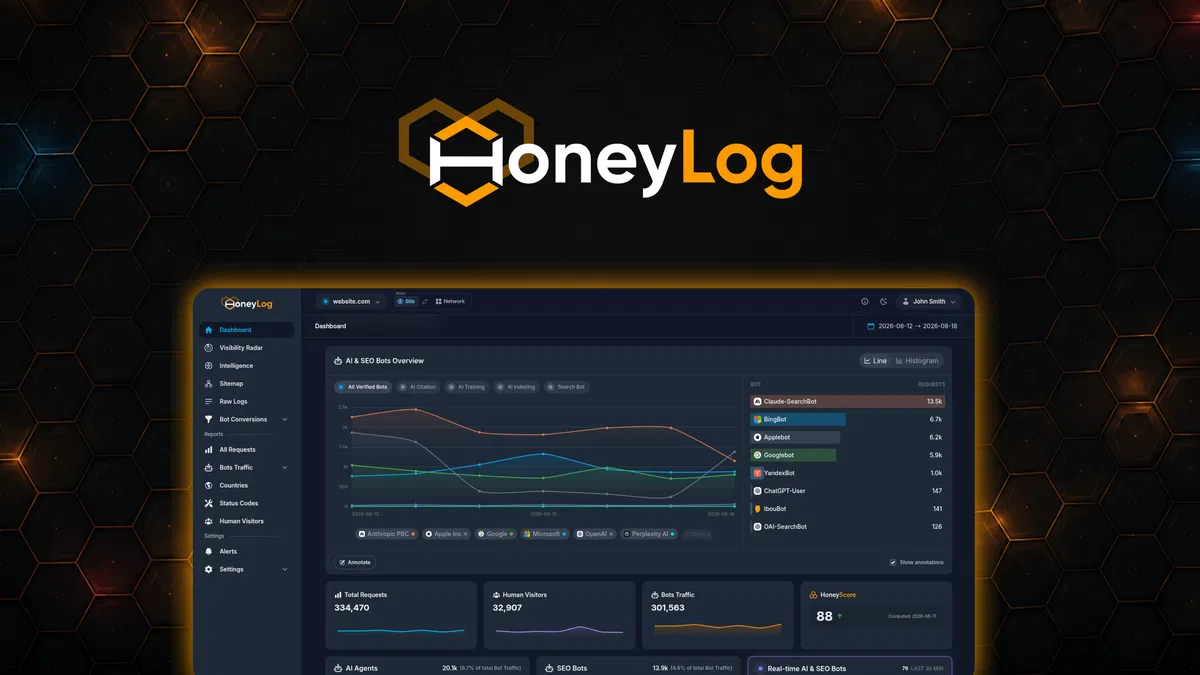
The dashboard shows visits, unique URLs, and growth trends for named AI crawlers, search bots, and other agents as they hit your server. You can filter by producer, so Googlebot traffic and GPT-style agents sit in separate buckets rather than one anonymous blob. That separation is what lets you answer "who is actually reading this page" without guessing.
Crawl-to-Human Attribution
This is the feature that separates Honeylog from a standard log viewer. It links bot crawls to human visits by producer and source, and it attributes that traffic through UTM tags and referrers without double counting. If you already run paid traffic attribution across your marketing stack, this adds the missing crawler-side half of the picture.
The practical output is a defensible list of which AI platforms convert crawler activity into real sessions.
Sitemap Intelligence
Honeylog compares the URLs you declared in your sitemap against the URLs bots actually fetch. Pages that get zero crawler attention show up as coverage gaps, which usually means an internal linking problem or an orphaned URL. Vendors and agencies can use that report to justify pruning or consolidation work with data instead of opinion.
Spoofed User Agent Detection
Scrapers frequently fake a Googlebot string to slip past basic filtering. Honeylog flags spoofed user agents so stealth scrapers stop masquerading as legitimate search traffic. If you have ever seen a crawl spike that never appeared in Search Console, this feature explains where it went.
Bot Management Markers and Alerts
You can mark frequent bots as allowed, blocked, or not managed, and Honeylog uses those labels to flag bypasses and behavior changes. Custom alerts fire when bot activity spikes or shifts, which is useful when a new AI agent starts hammering a product page. Higher license tiers raise the alert limit from 15 to 20.
Export and API Access
CSV reports come standard on every tier, and the complete export set is reserved for Tier 3 and above. API access starts at Tier 3 with 1,000 calls per minute, rising to 5,000 on Tier 4. That matters if you want to pipe bot data into automated content pipelines or a data warehouse rather than reading it in the browser.
Pricing Tiers (starts $59)
| Tier | Price | Best For | Free trial? |
|---|---|---|---|
| License Tier 1 | $59 one-time (was $129) | Solo site owners tracking 150,000 monthly events on 1 website | 60-day refund window |
| License Tier 2 | $149 one-time (was $349) | Small teams needing 300,000 events, 5 websites, 5 users | 60-day refund window |
| License Tier 3 | $249 one-time (was $789) | Agencies running 1M events across 10 websites, 10 users, 5 networks | 60-day refund window |
| License Tier 4 | $459 one-time (was $1,259) | High-traffic publishers at 2M events, 20 websites, 20 users, 10 networks | 60-day refund window |
Every tier is a one-time payment with lifetime access, and all four include the 60-day money-back guarantee plus AppSumo's "We Got Your Back" coverage for Plus members. The main levers are monthly event volume, website count, seat count, data retention, and API access. Tier 1 keeps six months of logs; Tier 2 and Tier 3 keep a year; Tier 4 keeps 1.5 years.
The upgrade math is simple. If you manage more than one site, Tier 1 runs out fast, so budget for Tier 2 at minimum. Agencies with client reporting obligations should look at Tier 3, because network support and custom alerts only appear at that level.
Pros and Cons
Pros
- Captures bots that never execute JavaScript, unlike GA4
- Shows which AI platforms send genuine human visitors
- Detects spoofed user agents impersonating Googlebot
- Sitemap audit exposes pages crawlers ignore completely
- Lifetime pricing removes recurring analytics subscription costs
- Alerts on crawl spikes and sudden behavior shifts
- Connects to Apache, NGINX, and WordPress setups
Cons
- Tier 1 covers a single website and a single user
- Six months of log retention on the entry plan
- Install requires server or CDN log access, which is technical
- API access and network support only from Tier 3 upward
- Review base on the AppSumo listing is still thin at 2 reviews
- Historical data import is not listed on every tier
Who Should Use Honeylog?
Ecommerce Teams With Large Catalogs
Product pages attract AI shopping agents, comparison scrapers, and training bots at volumes GA4 never reports. Honeylog shows which of those crawlers return and which ones convert into sessions, so you can prioritize the platforms worth optimizing for. Teams already managing product catalog feeds will recognize the same data-quality problem, just at the crawler level.
SEO and GEO Agencies
Agencies need evidence, not screenshots of a dashboard. Honeylog produces exportable crawl data per client domain, which supports GEO reporting, robots.txt compliance checks, and AI licensing conversations. Marketers juggling multiple channels can pair it with the social scheduling stack they already run and finally see how crawler attention maps to content performance.
Publishers Pursuing AI Licensing Deals
If you want to charge AI companies for content access, you need a record of who crawled what and how often. Honeylog's CSV exports and crawl history give you a paper trail, and teams publishing at volume often combine it with long-form drafting tools and automated feed distribution to keep output high. The log data becomes negotiating material rather than a vanity metric.
Who should skip it: anyone on a fully managed platform with no access to server or CDN logs, and anyone who only needs pageview counts. If your host will not expose raw logs, Honeylog has nothing to read.
Alternatives to Consider
Google Analytics 4 is free and familiar, but it only sees JavaScript-executing visitors, so AI crawlers and most bots stay invisible. Honeylog is the sharper tool when crawler behavior is the question.
Screaming Frog crawls your site from the outside and audits on-page SEO, but it cannot report who visited your server or how often. It complements Honeylog rather than replacing it.
Cloudflare bot analytics sits inside your CDN account and gives you bot scores and mitigation controls. It is convenient if you already use Cloudflare, though it reports on traffic passing through their network rather than your complete log history.
Final Verdict
Honeylog solves a specific problem well: it makes AI crawler activity countable on your own domain, and it ties that activity back to human visits you can actually measure. The lifetime pricing at $59 removes the usual subscription objection, and the 60-day refund window lowers the risk of testing it against your own logs. The trade-offs are real though, particularly the single-site Tier 1 limit and the technical install.
If you have server or CDN log access and you care about GEO performance, this is worth the $59. Get the Lifetime Deal →
Frequently Asked Questions
Does Honeylog have a free plan?
No. There is no free tier or time-limited trial, so the only way to evaluate it is to buy a license. AppSumo's 60-day money-back guarantee acts as the safety net instead, which gives you roughly two months to test it on live logs.
How does Honeylog compare to Google Analytics 4?
GA4 depends on JavaScript execution and uses sampling on larger properties, so it misses crawlers, AI agents, and script-blocking visitors. Honeylog reads server logs directly, which means every request appears regardless of client behavior. The two answer different questions, and most teams end up running both.
Can I cancel anytime?
There is nothing to cancel in the subscription sense, because every tier is a one-time lifetime purchase. If the tool does not fit, you request a refund through AppSumo within 60 days of purchase and the license is revoked. After that window, the license is yours permanently.
Can Honeylog detect AI crawlers that hide behind fake user agents?
Yes. Spoofed user agent detection is a named feature in the official listing, and it flags clients pretending to be Googlebot or another trusted crawler. That is the main defense against stealth scrapers that slip past simple user-agent filtering rules.
Is Honeylog worth the price?
At $59 for Tier 1, the value depends on how much crawler data is worth to you. A single wasted AI licensing negotiation or one unspotted scraper draining bandwidth can cost more than the license. Agencies and multi-site owners should weigh Tier 2 or Tier 3, where the per-site cost drops considerably.

