
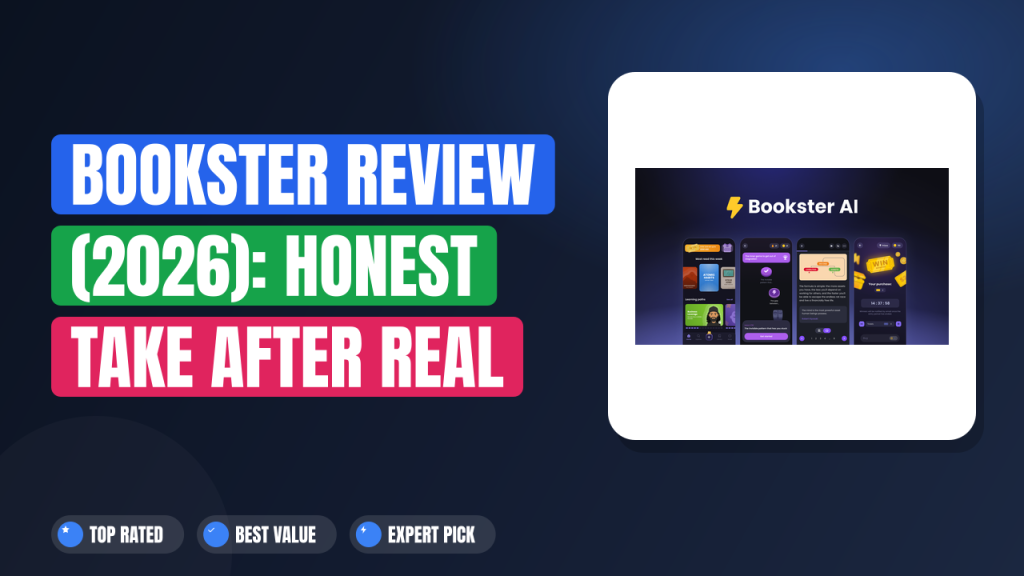
Bookster takes the 7 to 15 minute lesson format and bolts an AI quiz engine onto it, so you are not just reading summaries, you are being tested on them. That testing loop, combined with app blocking and a cash lottery, is what separates it from the pile of summary apps selling the same bestseller list. This Bookster review covers what the tool actually does, what the four AppSumo lifetime tiers cost, and who should walk away.

Disclosure: This article contains affiliate links. We may earn a small commission at no extra cost to you when you sign up via our links, it's how this site stays free to run.
TL;DR Verdict
- Best for: professionals and self-directed learners who want 7 to 15 minute lessons with quizzes instead of 6 hour audiobooks.
- Price: $19 one-time for License Tier 1, up to $249 one-time for License Tier 4, all lifetime through AppSumo.
- Biggest pro: AI-generated trivia and essay quizzes that force active recall instead of passive reading.
- Biggest con: Tier 1 caps you at 5 AI-generated summaries per month, which runs out fast.
- Trial status: no free plan and no free trial, but your purchase is refundable up to 60 days.
Bottom line: if you finish books but cannot recall them a week later, Get the Lifetime Deal →.
What Is Bookster?
Bookster is an AI learning app that turns books, podcasts, TED Talks, and your own uploaded documents into short lessons, then reinforces them with generated quizzes. The company launched on October 1, 2023, is based in Miami, and operates with a seed-funded team of 11 to 50 people.
The job it solves is not "find more content." Most people already have a backlog they will never clear. The job it solves is retention. You can sit through 8 hours of a business audiobook and remember two ideas by Friday.
Bookster compresses source material into a format you can finish in a coffee break, then makes you prove you understood it before the lesson counts as done.
The vendor reports over 1.5 million users and a number one ranking in the Book category across 13 countries. The official product home at bookster.ai documents the library, the learning paths, and the AI summarization workflow. Behind that library sits a simple loop: browse, read or listen, take the quiz, earn coins, keep the streak alive.
If your bottleneck is content intake rather than recall, a tool for curating content streams solves a different problem than this one.
Key Features That Matter
1. AI summaries of anything you upload
The library spans productivity, finance, entrepreneurship, stoicism, and marketing, with books available in both text and audio. The feature most buyers overlook is the upload box. Drop in a PDF, a video file, or a raw prompt, and Bookster generates a summary on the spot, then builds custom trivia and essay questions from your own material.
If you train a sales team on an internal playbook, that is the feature you will actually use every week.
2. AI trivia and essay quizzes
This is the retention engine, and it is the reason Bookster sits in a different category than a summary app. After each lesson you answer questions generated from what you just read, then you can go deeper with a second round tailored to the same content. The mechanics will feel familiar if you have ever built quizzes inside a self-hosted course builder, except here the questions write themselves in seconds.
3. Real-time competitive trivia
Bookster lets you test your knowledge against other users live and accumulate points as you go. It is a small feature in the product tour and a meaningful one for anyone who needs external pressure to keep showing up. Leaderboards do what good intentions do not.
4. App blocking
You can block TikTok, Instagram, YouTube, and anything else that eats your study time, and set your own rules for how those apps get unblocked. On mobile this is the difference between a 12 minute lesson and a 90 minute scroll. The honest caveat: browser-level blocking is always easier to bypass than an OS-level lock.
If your real problem is that you would rather schedule posts than doomscroll, the social scheduling tools we covered handle that side of the habit.
5. Coins, streaks, and the $100 lottery
Every activity pays coins: reading a summary, completing trivia, hitting a daily goal. You spend those coins on lottery tickets for a chance to win up to $100 a day, and Tier 2 and above get 10x the odds. The cash is the marketing hook.
The daily goals and streaks do the real work, because they give you a reason to open the app on day four, which is when most learning routines die.
6. Structured learning paths and 30-day courses
Paths are organized around outcomes like productivity, finance, and entrepreneurship, with original 3 to 7 minute lessons that are not AI-generated. You set daily goals that fit your schedule and the streak tracker keeps score. It plays the same role for learning that growth reporting tools play for marketing: a number you can watch move.
Pricing Tiers (starts $19)
| Tier | Price | Best For | Free trial? |
|---|---|---|---|
| License Tier 1 | $19 one-time | One user testing whether the habit sticks, 5 AI summaries per month | No, 60-day refund |
| License Tier 2 | $39 one-time | One heavy user who wants unlimited AI summaries and 10x lottery odds | No, 60-day refund |
| License Tier 3 (recommended) | $99 one-time | Three users, unlimited AI summaries, full library access | No, 60-day refund |
| License Tier 4 | $249 one-time | Ten users, unlimited AI summaries, team-wide deployment | No, 60-day refund |
Every tier includes lifetime access, the full text and audio book library, unlimited non-AI daily lessons, app blocking, and all new summaries and original content. The only real variables are user count, how many AI summaries you generate each month, and your lottery odds. Tier 1 is a $19 test drive.
Tier 2 fixes the one limit that actually bites, which is the 5 summaries per month cap. Tier 3 and Tier 4 exist for teams, and the per-seat math only makes sense if you have 3 or 10 people who will genuinely use it. All four tiers fall under AppSumo's 60-day money-back guarantee, so the risk window is two months rather than the usual 14 days.
Pros and Cons
Pros
- One-time payment at $19 removes subscription fatigue completely
- AI quizzes convert passive reading into active recall within minutes
- Upload your own documents and get summaries plus custom tests
- App blocking attacks the real reason study sessions fall apart
- Streaks and coins create a daily reason to open the app
- 1.5 million users and a top Book category ranking in 13 countries
Cons
- Tier 1 caps AI summaries at 5 per month, which is tight
- No free plan or trial, so you pay before you test
- Lottery payouts are variable, so treat them as a bonus
- Niche topics depend on what the internal team has covered
- Desktop app blocking is weaker than the mobile version
- Some AI-generated trivia questions still feel generic
Who Should Use Bookster?
The commuter who wants a habit, not a hobby
If you have 25 minutes on a train and a phone, Bookster fits the gap exactly. Podcast and TED Talk summaries mean you can learn without carrying a book, and the quiz at the end means the commute produces something you remember. This is the persona the product was clearly designed around.
The founder or operator who needs ideas fast
You do not need 300 pages on pricing strategy. You need the four decision rules inside it, today, before your next planning session. Upload your own board deck or a competitor's white paper and Bookster will summarize it and quiz you on the parts that matter.
It pairs well with an AI knowledge assistant if your team already runs on internal documentation.
Small teams running lunch-and-learns
Tier 3 gives you 3 user licenses and Tier 4 gives you 10, which maps neatly onto a small team doing a weekly 30 minute session. Assign a path, everyone reads the same 7 minute lesson, then run the competitive trivia mode as the group activity. It is cheaper and less administrative than licensing a formal LMS for a 6 person team.
Who should skip it: If you want full-length books, close reading, and highlight-level notes, this is the wrong tool. Readers who live inside a highlight capture and spaced repetition system will find Bookster's summaries too shallow. So will anyone who refuses to buy software without a free trial, and anyone who needs a certified LMS with compliance tracking.
If you want deep annotation, or you plan to read on a budget reading tablet with your own PDF library, other options fit better.
Alternatives to Consider
Blinkist offers a wider library and a stronger audio experience, but it is a recurring subscription and it will not generate quizzes from documents you upload. The trade-off is depth versus price.
Shortform goes deeper on each title with longer written guides, which suits people who want more than a summary. It has no lifetime deal and no app blocking, so the price comparison over 3 years is not close.
Readwise Reader is the strongest pick for capturing highlights across Kindle, articles, and PDFs, with spaced repetition built in. It does not include a structured course library or rewards, so it complements Bookster more than it replaces it.
Final Verdict
Bookster is a $19 one-time purchase that attacks a problem most learning apps ignore: you consume plenty, you retain almost none. The AI trivia from your own uploads is the feature that justifies the price, and the app blocking plus streak system is what keeps you using it past week two. It is not a replacement for reading actual books, and Tier 1 will frustrate anyone who uploads documents weekly.
Judge it as a retention tool for people who already consume content, and it earns its money back in the first month.
If that describes you, Get the Lifetime Deal →.
Frequently Asked Questions
Does Bookster have a free plan?
No. There is no free tier and no time-limited trial on the AppSumo deal. What you get instead is a 60-day refund window, which is longer than most SaaS trials.
You pay $19, use it properly for two weeks, and request a refund if the format does not fit how you learn.
How does Bookster compare to Blinkist?
Blinkist is a subscription library of summaries with strong narration and no quiz layer. Bookster adds AI-generated trivia, upload-your-own-document summarization, app blocking, and a one-time price. Blinkist wins on catalog breadth.
Bookster wins on retention mechanics and cost over time.
Can I cancel anytime?
There is nothing to cancel, because the AppSumo deal is a one-time lifetime purchase rather than a subscription. You either keep the license or request a refund within the 60-day window. After that window closes, the license stays active permanently with no renewal fee.
Is Bookster worth the price?
At $19 for Tier 1, one skipped takeaway lunch covers it. The value depends entirely on whether you use the quiz loop, because the summaries alone are a commodity. If you complete 3 or more lessons a week and finish the trivia each time, it pays for itself quickly.
If you only read summaries, a cheaper habit will do.
Does Bookster actually help you remember what you read?
The design is built around retrieval practice, which means you answer questions rather than reread notes. That is the same principle behind flashcards and study quizzes, and it is why the trivia step matters more than the summary itself. Results still depend on how consistently you show up, and the streak counter exists to make that easier.
Can I use Bookster with tools I already pay for?
Yes. Nothing here locks you into a single ecosystem. You can summarize a document, then move the ideas into AI writing assistants or your own notes for a project.
Bookster handles the input and the recall check, and your existing stack handles the output.

