
Discover Machine Learning Types of Algorithms and learn how each method boosts accuracy, reveals patterns, and drives smarter, data-powered results.
Whether you want to predict future trends, classify information, or find hidden patterns, knowing the right algorithm to use can make all the difference. You’ll discover the main categories of machine learning algorithms—supervised, unsupervised, semi-supervised, and reinforcement learning—and how each one can help you solve real-world problems.
Get ready to explore these algorithms in a simple and clear way that will boost your confidence and skills in machine learning. Keep reading to find out which algorithm fits your needs perfectly!
Are you curious about how machines learn from data and make smart decisions? Understanding the types of machine learning algorithms is the key to unlocking this powerful technology.
Whether you want to predict future trends, classify information, or find hidden patterns, knowing the right algorithm to use can make all the difference. You’ll discover the main categories of machine learning algorithms—supervised, unsupervised, semi-supervised, and reinforcement learning—and how each one can help you solve real-world problems.
Get ready to explore these algorithms in a simple and clear way that will boost your confidence and skills in machine learning. Keep reading to find out which algorithm fits your needs perfectly!
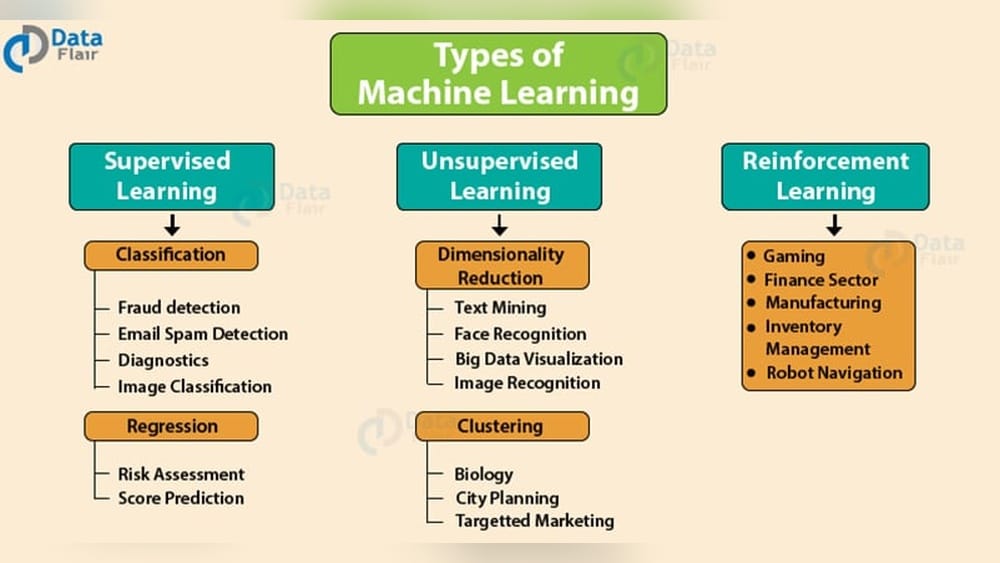
The four algorithm families covered in this guide and how they relate to smarter data decisions.
Credit: gerege.com
Supervised Learning
Supervised learning is a key type of machine learning. It uses labeled data to teach models. The model learns to predict outcomes from input data. This method is widely used in many real-world applications. It helps solve problems like spam detection and weather forecasting.
Classification Algorithms
Classification algorithms assign input data to specific categories. They work with discrete labels such as “spam” or “not spam.” Common tasks include image recognition and email filtering. These algorithms learn from past examples to make decisions. They improve accuracy by comparing predictions with actual labels.
Regression Algorithms
Regression algorithms predict continuous values instead of categories. They estimate numbers like house prices or temperatures. These models find relationships between input features and output values. They minimize the difference between predicted and real numbers. Regression helps in financial forecasting and risk assessment.
Popular Models
Some popular supervised learning models include decision trees, support vector machines, and neural networks. Decision trees split data into branches for clear decisions. Support vector machines find the best boundary between classes. Neural networks mimic the human brain to learn complex patterns. These models perform well with enough quality data.
When Supervised Learning Works Best
In practice, supervised learning is the right starting point when you have historical examples with known answers and you need to predict the same kind of answer for new data. A common mistake is assuming more data fixes poorly chosen labels; noisy labels can mislead even powerful models. The same workflow that predicts house prices can also be adapted to portfolio and risk decisions, which is why finance teams often apply these models to market forecasting.
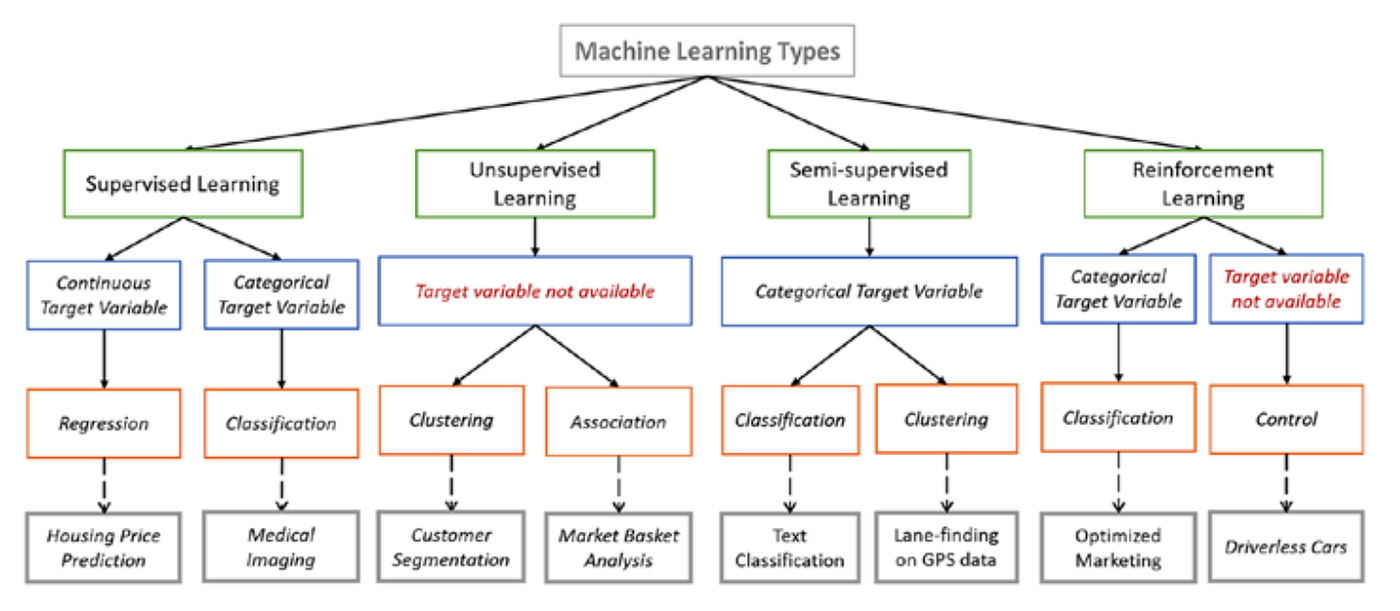
Supervised learning splits labeled data into classification and regression tasks.
Credit: ai.plainenglish.io
Unsupervised Learning
Unsupervised learning is a type of machine learning where the system learns patterns from data without labeled answers. The algorithm explores the data on its own to find hidden structures. This approach helps when we do not have predefined categories or outcomes. It is useful for discovering relationships and grouping data based on similarities.
Clustering Techniques
Clustering groups similar data points into clusters. Each cluster contains data that shares common features. Popular methods include K-means, Hierarchical clustering, and DBSCAN. These techniques help organize data into meaningful groups without prior knowledge. Clustering is widely used for customer segmentation and image analysis.
In practice, choosing the right clustering algorithm depends heavily on the shape and scale of your data. K-means assumes spherical clusters of similar size, while DBSCAN can find arbitrarily shaped clusters and handles noise well. A common mistake is to run clustering without standardizing features first, which allows variables with large numeric ranges to dominate the distance calculation. When you are segmenting customers by purchase behaviour, standardizing spending metrics against frequency prevents one dimension from skewing the results.
Dimensionality Reduction
This technique reduces the number of variables in data while keeping important information. It simplifies complex data, making it easier to analyze and visualize. Principal Component Analysis (PCA) and t-SNE are common methods. Dimensionality reduction helps improve speed and performance of machine learning models.
When working with high-dimensional datasets, such as pixel values from images or thousands of sensor readings, PCA can compress the data into a handful of components that capture most of the variance. A practical trade-off is interpretability: the new components are linear combinations of original features, so you lose the direct meaning of individual inputs. t-SNE, by contrast, excels at producing two- or three-dimensional plots that reveal clusters, but it is stochastic and not suitable for making predictions on new data.
Use Cases
Unsupervised learning is valuable in many fields. It helps detect fraud by identifying unusual patterns. In marketing, it segments customers based on behavior. In healthcare, it finds new disease patterns from patient data. These examples show how unsupervised learning reveals insights without labeled data.
Operational teams also rely on unsupervised methods for anomaly detection in manufacturing equipment. By monitoring sensor data and flagging points that fall outside normal clusters, maintenance can be scheduled before a breakdown occurs. This approach has become a standard part of modern predictive maintenance strategies.
Semi-supervised Learning
Semi-supervised learning is a type of machine learning algorithm. It uses both labeled and unlabeled data to train models. This approach sits between supervised and unsupervised learning. It helps improve learning accuracy with less labeled data. This method is useful when labeling data is expensive or time-consuming.
Combining Labeled And Unlabeled Data
Semi-supervised learning starts with a small amount of labeled data. Then, it adds a large amount of unlabeled data. The model learns patterns from both sets. Labeled data guides the learning process. Unlabeled data helps the model understand the data structure better. This combination reduces the need for extensive manual labeling.
Applications
Semi-supervised learning works well in many fields. It is used in image recognition to improve accuracy with fewer labels. It helps in speech recognition by learning from vast unlabeled audio. In medical diagnosis, it supports models with limited labeled patient data. It also aids text classification and natural language processing tasks. This learning type offers practical solutions in real-world problems.
For example, a hospital might have only a few hundred labeled CT scans but thousands of unlabeled ones. A semi-supervised model can leverage the unlabeled scans to learn general anatomical patterns, then fine-tune on the labeled set to detect tumours. This reduces the annotation burden on radiologists while maintaining high diagnostic accuracy.
Reinforcement Learning
Reinforcement learning is a unique type of machine learning. It teaches computers to make decisions by trying actions and learning from results. The process involves an agent that interacts with an environment and receives feedback. Over time, the agent learns which actions lead to better outcomes. This type of learning is useful in robotics, gaming, and many automated systems.
Agent And Environment Interaction
In reinforcement learning, the agent takes actions in an environment. The environment responds with new situations and rewards. The agent's goal is to choose actions that maximize long-term rewards. This interaction is continuous, forming a feedback loop. The agent learns by exploring and exploiting the environment.
Reward Systems
Rewards guide the agent's learning process. Positive rewards encourage good actions. Negative rewards or penalties discourage poor choices. The agent uses these rewards to update its strategy. The reward system helps the agent understand which actions work best. This system is key to improving performance over time.
Common Algorithms
Several algorithms power reinforcement learning. Q-learning helps agents learn the value of actions. Deep Q-Networks combine Q-learning with neural networks. Policy Gradient methods optimize the agent’s policy directly. Actor-Critic algorithms blend value and policy learning. These algorithms are popular for solving complex decision problems.
One common real-world use is robotic arm manipulation in warehouses. The agent receives a reward each time it successfully picks and places an item, and a penalty when it drops one. By balancing the need to try new movements against repeating known good ones, the robot gradually achieves speeds that rival human operators. The same principles now drive self-driving car behaviour planners and dynamic pricing engines.
Algorithm Selection Factors
Selecting the right machine learning algorithm is vital for project success. Several factors influence this choice. Understanding these factors helps you pick the best algorithm for your needs.
Data Type And Quality
The kind of data you have affects algorithm choice. Some algorithms work best with numbers, others with text or images. Data quality matters too. Clean, accurate data leads to better results. Noisy or missing data can confuse algorithms and reduce performance.
Problem Complexity
Simple problems need simpler algorithms. Complex problems may require advanced models. Consider how many features your data has. Also, think about the relationships within data. Complex patterns need algorithms that can capture them well.
Performance Metrics
Different tasks require different success measures. Accuracy suits classification problems. Mean squared error fits regression tasks. Speed and memory use also matter. Choose an algorithm that balances performance and resources.
When selecting an algorithm, also consider the size of your dataset. Deep neural networks typically need thousands of examples to generalise, whereas simpler models like logistic regression can perform well on smaller, well-structured datasets. If you operate within a tight budget, look for approaches that align with your data volume rather than forcing a complex model onto a sparse sample.
Real-world Applications
Machine learning algorithms power many tools and services used daily. These algorithms analyze data patterns and help make decisions without human intervention. Their ability to learn from data makes them useful across various industries.
Understanding real-world applications shows how different algorithms solve unique problems. From security to marketing, machine learning adapts to many fields with ease.
Facial Recognition
Facial recognition uses machine learning to identify people by their faces. Algorithms learn features like eyes, nose, and mouth shapes. This technology helps unlock phones, verify identities, and enhance security. It quickly compares faces against large databases to find matches. Facial recognition improves safety in airports and public places.
Customer Segmentation
Customer segmentation groups people based on their behavior and preferences. Machine learning finds patterns in purchase history, browsing habits, and demographics. Businesses use these groups to target ads and offers more effectively. This helps companies increase sales and keep customers happy. Segmentation makes marketing smarter and more personalized.
Predictive Analytics
Predictive analytics uses past data to forecast future events. Machine learning models identify trends and predict outcomes like sales or equipment failure. This helps companies plan better and reduce risks. For example, stores predict product demand to manage stock. Predictive analytics improves decision-making in many industries.
Applying these methods in your own organisation starts with understanding which type of algorithm fits your raw material. If you are working with historical transaction data that already has labels, supervised learning is the natural entry point. For customer behaviour data without predefined groups, unsupervised clustering reveals segments you can act on. Blending both approaches is where most mature data teams see the greatest return.
Challenges And Best Practices
Machine learning algorithms face many challenges that affect their success. Understanding these challenges helps create better models. Best practices improve accuracy and efficiency. This section covers key challenges and tips to handle them.
Overfitting And Underfitting
Overfitting happens when a model learns too much from training data. It performs well on training but poorly on new data. Underfitting occurs when a model is too simple. It cannot capture the data's patterns well. Balance is essential. Use techniques like cross-validation and regularization to avoid these issues.
Data Preprocessing
Data quality impacts machine learning results. Raw data often contains noise, missing values, and errors. Clean data by removing duplicates and filling missing values. Normalize or scale features to help algorithms learn better. Good preprocessing reduces errors and speeds up training.
Model Evaluation
Evaluating a model shows how well it performs. Use metrics like accuracy, precision, recall, and F1-score. Split data into training and testing sets to check performance on unseen data. Regularly evaluate models to detect problems early. This practice ensures reliable and robust results.
A practical tip: always keep a hold-out test set that you never peek at during development. Even cross-validation can leak information if you repeatedly tune hyperparameters on the same folds. The National Institute of Standards and Technology publishes guidelines for reproducible evaluation that many practitioners follow to avoid over-optimism in reported results. By holding back a final test set, you get an honest picture of how your model will perform in production.
The full model lifecycle showing iterative evaluation and validation stages.
Credit: www.sinfoniagulfcoast.org
Start building your first model today — our step-by-step guide walks you from data collection to deployment.
Frequently Asked Questions
What Are The 4 Types Of Machine Learning Algorithms?
The four types of machine learning algorithms are supervised, unsupervised, semi-supervised, and reinforcement learning. Each type learns differently from data to make predictions or decisions.
What Are The 7 Types Of Machine Learning?
The seven types of machine learning are supervised, unsupervised, semi-supervised, reinforcement, self-supervised, deep learning, and evolutionary learning. Each type uses different data and techniques to train models for specific tasks and improve performance over time.
What Are The Top 10 Machine Learning Algorithms?
Top 10 machine learning algorithms are Decision Trees, Random Forest, Support Vector Machines, K-Nearest Neighbors, Linear Regression, Logistic Regression, Gradient Boosting, K-Means Clustering, Principal Component Analysis, and Neural Networks. These algorithms handle classification, regression, and clustering tasks efficiently.
What Are The Main 3 Types Of Ml Models?
The main three types of ML models are supervised, unsupervised, and reinforcement learning. Supervised learns from labeled data. Unsupervised finds patterns in unlabeled data. Reinforcement learns by receiving rewards or penalties through interaction.
How Do I Choose Between Classification And Regression?
Classification outputs a discrete label, while regression outputs a continuous number. If your target is a category such as "will the customer churn? (yes/no)", use classification. If your target is a numeric value such as "expected revenue next month", use regression. The same dataset can often support both tasks depending on the question you ask.
Do I Need To Label All Data Before Training?
No. Unsupervised learning works entirely without labels. Semi-supervised learning uses a small set of labels alongside a much larger unlabeled pool. Reinforcement learning never uses explicit labels—it learns from reward signals. Only supervised learning requires fully labeled training data. For many real-world projects, semi-supervised and unsupervised approaches offer a faster path to value.
Conclusion
Machine learning uses different algorithms to solve problems. Each type serves a unique purpose. Supervised learning needs labeled data to predict outcomes. Unsupervised learning finds patterns without labels. Reinforcement learning learns by trial and error. Choosing the right algorithm depends on your data and goals.
Understanding these types helps you apply machine learning effectively. Keep exploring to see how algorithms shape technology today. To go deeper, explore how these techniques apply to machine learning in operations and discover business intelligence architecture patterns that complement your algorithm choices.

